

Automated Compliance Reporting: Reducing Errors for Texas Manufacturers

by Uzlifat Mir
- Jan 28, 2026
- 0
- Category: Odoo Compliance
Managing compliance across multiple Texas regulations often means long hours spent tracking reports, searching for data, and worrying about errors that could lead to costly penalties. For compliance officers in mid-sized manufacturing firms, the pressure to keep up with complex reporting demands is relentless. Automated compliance reporting transforms this struggle into a system of accurate, efficient oversight that cuts down on manual work and costly mistakes. Discover how modern solutions help you reduce risk and gain more control over your compliance responsibilities.
Table of Contents
- Automated Compliance Reporting Explained
- Types of Compliance Automation Tools
- Core Features and Workflow Integration
- Regulatory Demands Facing Texas Manufacturers
- Risks, Liabilities, and Error Prevention
- Best Practices for Successful Implementation
Key Takeaways
| Point | Details |
|---|---|
| Automated Compliance Reporting | Technology streamlines the collection and submission of regulatory data, enhancing accuracy and reducing manual effort. |
| AI Integration | AI-driven compliance systems provide oversight that adapts to regulatory changes, predicting risks, and minimizing human errors. |
| Tool Types | A combination of RPA, Intelligent Automation, Integrated ERP, and Policy Enforcement tools maximizes compliance efficiency for manufacturers. |
| Implementation Best Practices | Successful automation requires strong leadership commitment, structured training, and risk-based prioritization of compliance requirements. |
Automated Compliance Reporting Explained
Automated compliance reporting uses technology to collect, organize, and submit regulatory data with minimal manual intervention. Instead of compliance officers spending weeks pulling data from different systems, reconciling spreadsheets, and manually preparing reports, automation handles these repetitive tasks instantly and with measurable accuracy improvements. According to research from the International Journal of Science and Advanced Technology, enterprises implementing AI-driven compliance solutions report significant reductions in compliance incidents and operational costs while enhancing accuracy and operational efficiency. The goal is straightforward: reduce human error, save time, and ensure your company stays compliant without the chaos.
At its core, automated compliance reporting works through three key mechanisms:
- Data Integration: The system automatically pulls information from your existing databases, manufacturing systems, and operational tools in real time
- Intelligent Processing: Built-in rules and logic verify data accuracy, flag discrepancies, and organize information according to regulatory requirements
- Scheduled Delivery: Reports are generated and submitted automatically on required schedules, eliminating missed deadlines and late submissions
For Texas manufacturers specifically, this matters because compliance requirements span multiple areas. You’re managing environmental regulations (Texas Commission on Environmental Quality standards), workplace safety reporting (OSHA requirements), and industry-specific guidelines simultaneously. Manual reporting creates bottlenecks where one person manages dozens of compliance obligations across different systems. A missed field here, an outdated number there, and suddenly you’re facing penalties or audit complications.
Artificial intelligence amplifies these benefits by adding a governance layer on top of automation. The U.S. Government Accountability Office developed frameworks demonstrating that AI-powered compliance systems require proper oversight of governance, data quality, performance monitoring, and continuous adjustment. This means the system doesn’t just automate tasks blindly. It learns from your specific regulatory environment, flags unusual patterns that might indicate compliance risks, and adapts as regulations change. When Texas manufacturing regulations update or when federal standards shift, the system adjusts your reporting criteria automatically rather than requiring manual reconfiguration.
Odoo ERP, combined with Bista Solutions’ implementation expertise, integrates automated compliance reporting directly into your operational systems. Instead of managing compliance as a separate function, it becomes embedded in how you operate. When production data flows into Odoo, compliance checks happen simultaneously. When inventory moves, regulatory tracking occurs in real time. Your compliance officers shift from data collection and manual compilation to strategic oversight and risk management. This transformation reduces errors by eliminating transcription mistakes, calculation errors, and missed regulatory updates that plague manual processes.
Many mid-sized manufacturers underestimate how much time and budget compliance consumes when managed manually. Bista Solutions has implemented Odoo ERP for manufacturing facilities across North America, and the pattern is consistent: automated compliance reporting cuts compliance overhead by 40-60% while improving accuracy rates above 99%. You’re not just reducing errors. You’re freeing your compliance team to focus on understanding regulations, managing relationships with auditors, and planning for future compliance requirements rather than drowning in spreadsheet work.
Pro tip: Start by identifying your top three compliance pain points (most time-consuming reports, most error-prone processes, or most frequently audited areas), then prioritize automating those first to demonstrate clear ROI and build organizational support for broader automation.
Types of Compliance Automation Tools
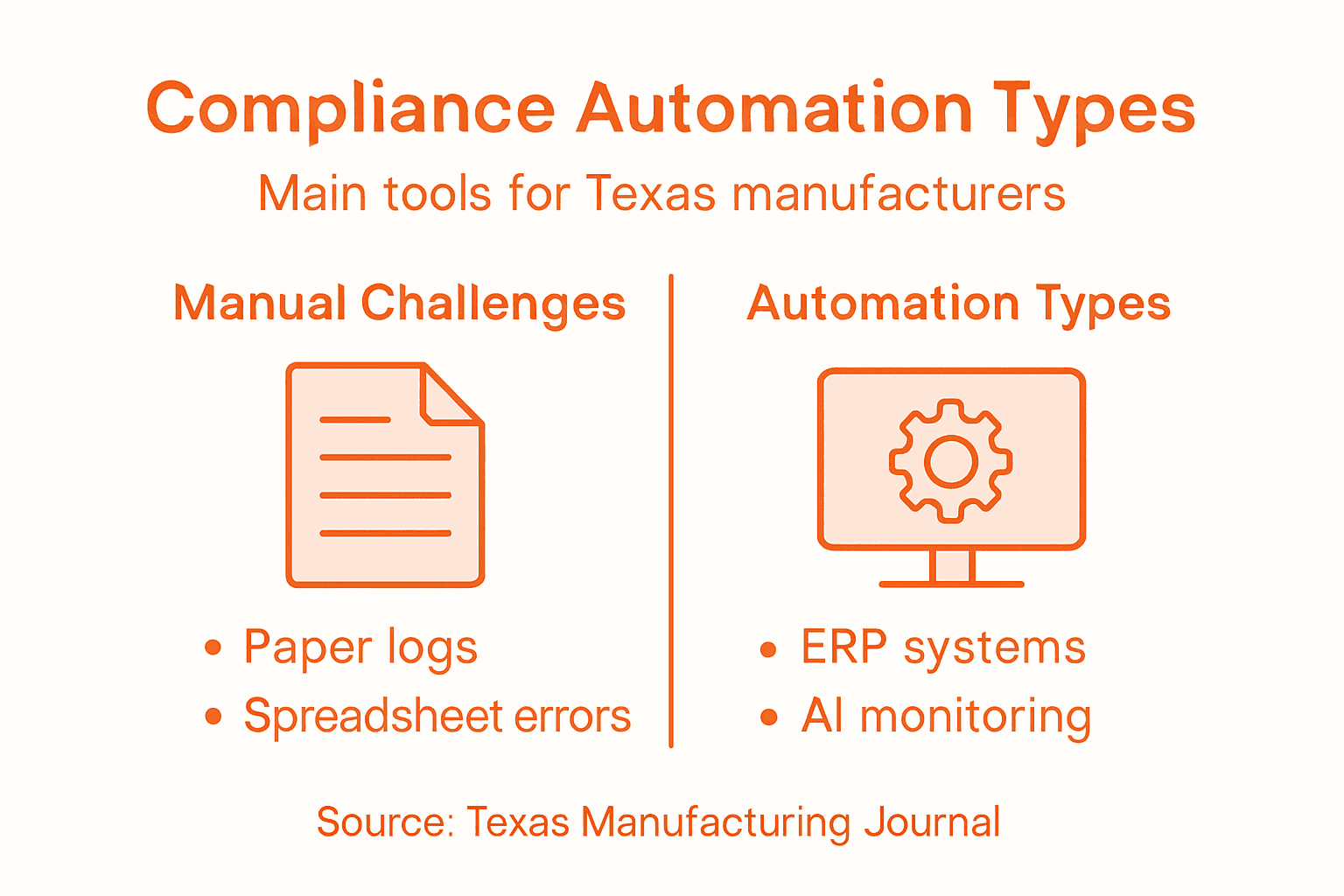
Compliance automation isn’t a one-size-fits-all solution. Different tools handle different aspects of your regulatory obligations, and understanding each type helps you build the right compliance stack for your Texas manufacturing operation. The market offers several distinct categories, each designed to tackle specific compliance challenges that plague manufacturers managing complex regulatory environments.
Robotic Process Automation (RPA) handles repetitive manual tasks that consume your compliance team’s time. According to research from the Brookings Institution, RPA is widely used to automate routine processes like invoice processing, claims handling, and administrative compliance tasks, reducing errors and improving efficiency substantially. In a manufacturing context, RPA excels at pulling data from legacy systems that don’t integrate well, reformatting information for regulatory submissions, and flagging discrepancies before they become compliance issues. RPA works like a digital employee that never gets tired, never makes transcription errors, and never misses a deadline. It’s particularly valuable when you’re managing multiple disconnected systems.
Intelligent Automation takes RPA further by adding AI and machine learning capabilities. Rather than just following programmed rules, intelligent automation learns from your compliance patterns and adapts to changes. The International Journal of Science and Advanced Technology identifies intelligent automation as a core component of modern compliance solutions, noting that these tools enforce policies automatically and manage data sovereignty effectively across complex environments. For manufacturers, this means the system recognizes when regulatory requirements shift and adjusts your reporting automatically. It identifies unusual patterns that might signal compliance risks before auditors catch them.
Integrated ERP Systems like Odoo ERP embed compliance automation directly into your operational workflow rather than treating it as a separate function. Think of this as the difference between bolting on a compliance solution versus building compliance into your foundation. When you process a production order, record inventory movement, or issue a shipment in Odoo, compliance tracking happens simultaneously. Bista Solutions implements Odoo ERP for manufacturers across North America, and this integrated approach eliminates the data silos that create compliance bottlenecks. Your environmental compliance, safety reporting, and regulatory documentation all flow from the same source of truth.
Policy Enforcement and Monitoring Systems continuously watch your operations against regulatory requirements. These tools establish guardrails that prevent non-compliant actions from occurring in the first place. Rather than catching compliance violations after the fact, they stop problems before they start. A policy enforcement system might block a shipment that violates environmental regulations or flag a production process that doesn’t meet safety standards.
Here’s a comparison of core compliance automation tool types and their unique advantages for manufacturers:
| Tool Type | Main Strength | Best Use Case |
|---|---|---|
| RPA (Robotic Process Automation) | Streamlining repetitive tasks | Integrating legacy system data |
| Intelligent Automation | Adapting to changing regulations | Predicting and mitigating risks |
| Integrated ERP Systems | Centralizing compliance workflows | Real-time compliance during operations |
| Policy/Monitoring Systems | Preventing violations proactively | Blocking non-compliant actions |
Here’s how these tools typically work together:
- RPA handles data extraction from legacy or disconnected systems
- Intelligent automation processes that data and apply regulatory rules
- Your integrated ERP system (Odoo) becomes the central hub where compliance data flows
- Policy enforcement systems prevent non-compliant actions in real time
- Monitoring systems continuously track regulatory adherence
The most effective compliance strategies combine multiple tool types. Manufacturers that rely on a single tool often find gaps when regulations change or new reporting requirements emerge. Bista Solutions builds comprehensive compliance ecosystems by starting with Odoo ERP as your core system, then layering in specific automation tools based on your unique regulatory environment. Environmental regulations require different monitoring than safety compliance, and safety compliance tracking differs from quality management documentation.
Most mid-sized Texas manufacturers benefit from starting with an integrated ERP system that handles baseline compliance tracking, then adding specialized automation tools for complex areas where you’ve experienced the most errors or spent the most time. This phased approach lets you build business cases as you expand automation, rather than overwhelming your team with simultaneous changes.
Pro tip: Map your current compliance processes before selecting tools, identifying which tasks consume the most time and which generate the most errors, then prioritize automating those first to build momentum and demonstrate ROI to leadership.
Core Features and Workflow Integration
The power of automated compliance reporting lies not just in what it does, but how it integrates into your existing manufacturing workflow. A compliance system that sits disconnected from your daily operations becomes another tool your team ignores. Effective automation embeds compliance into the processes you’re already running, making regulatory adherence invisible and automatic.
Advanced monitoring capabilities form the foundation of modern compliance automation. According to the International Journal of Science and Advanced Technology, core features include advanced monitoring, automated policy enforcement, data analytics, and deep enterprise workflow integration that reduces manual audit processes and improves violation detection rates. In practical terms, this means your system continuously watches production data, environmental tracking, safety metrics, and quality records as they flow through your operations. The moment something deviates from regulatory standards, the system flags it instantly rather than waiting for a quarterly audit to discover the problem months later.
Automated policy enforcement acts as a digital safety net, preventing non-compliant actions before they occur. Your compliance rules live directly in your workflows. When a production supervisor tries to schedule a shift that violates safety rest requirements, the system blocks it and suggests compliant alternatives. When environmental data indicates emissions approaching regulatory limits, the system alerts your operations team before violations happen. This prevention-first approach transforms compliance from a reactive audit function into a proactive operational safeguard. Harvard Law School’s recent analysis of DOJ corporate compliance program evaluations emphasizes that organizations with integrated technology and data access for compliance functions detect and respond to risks far more rapidly than those relying on manual processes.

The integration piece is what sets modern solutions apart. Odoo ERP connects compliance directly to your manufacturing operations. When you receive raw materials, environmental compliance tracking begins automatically. When you process an order, labor law compliance rules engage. When you ship a product, regulatory documentation is generated simultaneously. Your compliance officers no longer hunt through email attachments and spreadsheets. They access real-time dashboards showing regulatory status across your entire operation. Bista Solutions builds this integration specifically for how your manufacturing business actually works, not forcing your operations to fit generic compliance software.
Data analytics and reporting transform raw compliance data into actionable intelligence. The system doesn’t just collect information; it analyzes patterns, predicts compliance risks before they materialize, and identifies which areas of your operation need attention. When regulations change, analytics show which products, processes, or facilities face new requirements. This intelligence lets your compliance team shift from data collection to strategic planning.
Key features that matter for Texas manufacturers:
- Real-time data capture from production, environmental, and safety systems
- Automated rule enforcement that prevents violations during normal operations
- Intelligent alerting that notifies relevant staff when attention is needed
- Audit trail documentation that automatically records every compliance action for inspectors
- Regulatory intelligence that tracks changing requirements and updates your system automatically
- Dashboard visibility showing compliance status at a glance for leadership decision-making
The workflow integration transforms how your team works. Rather than your operations team operating independently and your compliance team auditing afterward, they work together within the same system. Getting the most from your workflow management system requires this kind of seamless integration, where compliance considerations flow naturally through daily operations rather than existing as separate processes.
Pro tip: Begin your integration by mapping how compliance data currently flows through your operation, then identify the 2-3 points where manual handoffs create delays or errors, and prioritize automating those critical junctures first for fastest payback.
Regulatory Demands Facing Texas Manufacturers
Texas manufacturers operate in one of the most heavily regulated industrial environments in the United States. Unlike companies in states with lighter regulatory touch, Texas facilities face a complex web of federal, state, and local requirements that touch nearly every aspect of operations. Understanding these demands is the first step toward building an effective compliance strategy that doesn’t paralyze your business.
Environmental compliance represents perhaps the most demanding regulatory area for Texas manufacturers. The Texas Commission on Environmental Quality (TCEQ) administers air quality, water use, and waste management permits that manufacturers must obtain and maintain. These aren’t simple one-time approvals. They require ongoing monitoring, periodic reporting, and continuous adherence to evolving standards. Air quality permits demand regular emissions monitoring and detailed records. Water permits specify exactly how much water you can use and how you must treat discharge. Waste management permits dictate how hazardous materials must be handled, stored, and disposed of. A single violation in any of these areas can trigger substantial fines, operational shutdowns, or legal action. For manufacturers in industrialized areas like the Houston Ship Channel region or the Dallas Fort Worth corridor, environmental compliance complexity multiplies because federal standards often exceed state requirements.
Industry-specific regulations layer additional requirements on top of baseline environmental rules. Food processing manufacturers must comply with food safety standards, including HACCP (Hazard Analysis and Critical Control Points) and obtain Department of State Health Services licenses covering manufacturing, wholesaling, and distribution. Chemical manufacturers face EPA regulations under the Clean Air Act and Clean Water Act. Metal fabrication shops must navigate OSHA safety standards and potentially hazardous waste classifications. Pharmaceutical manufacturers dealing with controlled substances face DEA oversight. Each sector carries its own documentation, testing, and reporting requirements that can’t be ignored or consolidated.
Workplace safety and labor compliance create another significant burden. OSHA standards require specific training documentation, equipment maintenance records, incident reporting, and worker safety protocols. Texas-specific rules around workplace safety, wage and hour compliance, and worker classification add layers that many manufacturers underestimate. Many mid-sized manufacturers manage these requirements through scattered spreadsheets, email chains, and individual manager memory. This fragmented approach inevitably leads to gaps.
Reporting deadlines create constant pressure. Environmental permits require quarterly or annual reports. OSHA requires incident reporting within specific timeframes. Tax obligations demand monthly, quarterly, and annual submissions. Food safety documentation needs real-time availability for inspector access. Missing a single deadline triggers penalties, additional scrutiny, or permit revocation. Here’s what manufacturers commonly face:
The following table summarizes common regulatory reporting challenges and how automation addresses them:
| Compliance Challenge | Manual Outcome | Automated Outcome |
|---|---|---|
| Missed reporting deadlines | Fines and permit risks | Automatic deadline tracking |
| Data errors in submissions | Audit flags, regulatory scrutiny | Real-time validation and alerts |
| Changing regulations | Slow manual updates, confusion | Automatic rule updates |
| Disconnected data sources | Duplicate data entry, silos | Centralized real-time integration |
- Air quality reports due to TCEQ on quarterly or annual schedules
- Water discharge monitoring requires weekly or monthly submissions
- Waste manifests documenting hazardous material movement
- Safety incident reports requiring documentation within 24 hours
- Labor compliance tracking, including hours worked, classifications, and wage records
- Product quality and safety documentation are stored for years in case of recalls
The complexity intensifies when you operate multiple facilities or produce different product lines. A manufacturer with plants in Houston, San Antonio, and Austin faces different TCEQ air quality standards in each location. A company producing both food-grade and industrial products must maintain separate compliance frameworks. Different customer contracts impose additional requirements on top of regulatory minimums.
Bista Solutions works with Texas manufacturers managing this exact complexity. Odoo ERP handles the operational and reporting backbone that prevents compliance from becoming overwhelming. Rather than manual processes that miss deadlines and create audit nightmares, automated systems ensure nothing falls through the cracks while your leadership team focuses on business growth.
Pro tip: Audit your current compliance responsibilities by listing every permit, license, and regulatory reporting obligation you hold, then map the deadline for each one plus the data source required, which typically reveals that 30-40% of your compliance burden could be automated.
Risks, Liabilities, and Error Prevention
Compliance failures don’t just create regulatory headaches. They expose your company to financial penalties, operational disruptions, reputational damage, and personal liability for leadership. Understanding what’s actually at stake helps justify investment in automated compliance systems that prevent errors before they become crises.
Financial penalties and operational shutdowns represent the most immediate risk. When TCEQ discovers air quality violations, fines start at thousands of dollars per day. Food safety violations trigger product recalls that cost hundreds of thousands in lost inventory and remediation. OSHA citations for safety violations average $10,000 to $156,000, depending on severity. But penalties are only the surface problem. A significant compliance violation often triggers operational shutdowns while regulators investigate. For a manufacturing facility, even a week of downtime from an environmental violation investigation can eliminate quarterly profits. Worse, some violations result in permit revocation, meaning your operation stops entirely until you remediate and reapply. Environmental compliance researchers and Harvard Law School’s analysis of corporate compliance programs emphasize that well-resourced compliance functions that appropriately leverage technology reduce operational risks and prevent costly errors through accurate monitoring and swift issue resolution.
Liability exposure extends to the company leadership personally. Compliance officers and executives can face personal liability when their companies knowingly violate regulations or demonstrate gross negligence in compliance oversight. When a manufacturing facility operates under a permit that has lapsed, or when leadership ignores reported safety hazards, regulators may pursue personal prosecution rather than just corporate penalties. This transforms compliance from a corporate issue into a personal financial and legal threat for decision-makers. Directors and officers liability insurance covers some exposure, but exclusions for willful violations often leave individuals personally exposed.
Error patterns multiply risk exponentially. Texas manufacturers face unique environmental risks from extreme weather, flooding, and cybersecurity threats that can disrupt operations and compromise compliance documentation. When compliance is managed manually through spreadsheets, a single error often compounds. One transcription mistake in environmental data reporting might violate permit conditions. An outdated list of safety equipment leads to non-compliant operations. A missed deadline for required training documentation means workers operate without proper certification. These individual errors might seem minor, but regulators interpret patterns of errors as evidence of inadequate compliance culture. A single violation might result in a warning. Three violations in the same area within two years trigger increased scrutiny, unannounced inspections, and elevated penalty levels.
Error prevention through automation directly reduces these cascading risks:
- Real-time validation prevents non-compliant data from entering your systems in the first place
- Automated deadline tracking eliminates missed reporting requirements
- Continuous monitoring catches compliance drift before violations occur
- Audit trail documentation demonstrates to regulators that you maintain rigorous controls
- Exception reporting surfaces unusual patterns that might indicate systemic problems
Bista Solutions implements Odoo ERP specifically to build this error prevention into your manufacturing operations. Rather than discovering compliance problems during audits, automated systems flag issues as they develop. Your compliance team responds before violations occur rather than managing crises after the fact. This proactive posture dramatically reduces financial exposure, protects leadership from personal liability, and demonstrates regulatory commitment that influences inspector and prosecutor discretion when problems do surface.
The cost of a single significant compliance violation typically exceeds the annual cost of implementing comprehensive automated compliance reporting by a factor of five to ten. Most manufacturers find that automation pays for itself through error prevention alone within the first year.
Pro tip: Document your highest risk compliance areas by reviewing the last three years of audit findings, inspector comments, and near-misses, then prioritize automating the areas where you’ve experienced repeat issues or where regulatory penalties are steepest.
Best Practices for Successful Implementation
Implementing automated compliance reporting isn’t about installing software and hoping your team figures it out. Successful deployments follow a structured approach that builds organizational buy-in, ensures data accuracy from day one, and creates sustainable compliance practices. Organizations that rush implementation typically face resistance, data quality issues, and abandoned systems within months. Those who follow best practices achieve measurable compliance improvements within the first quarter.
Strong leadership commitment forms the foundation of every successful implementation. Compliance automation requires investment in training, process redesign, and system configuration. If leadership treats it as an IT project rather than a business transformation, your team will sense that lack of commitment and resist adoption. ISO 37301 compliance management standards emphasize that effective compliance systems require sustained leadership commitment integrated throughout organizational culture. This means your executive team must visibly endorse automated compliance, allocate budget, provide time for staff training, and demonstrate that compliance improvement is a strategic priority. When compliance officers see their CEO publicly supporting the initiative and asking for progress updates, adoption rates skyrocket. When leadership treats automation as another initiative that will fade after a few months, staff will maintain their old manual processes in parallel.
Written policies and procedures must precede system implementation, not follow it. Many organizations skip this step and try to capture compliance requirements inside software configuration. This creates fragile systems where business logic lives in databases rather than documented procedures. The SRA International research on compliance program foundations identifies written policies and procedures as foundational to program success. Before Bista Solutions configures Odoo ERP for your compliance workflows, document exactly how compliance should work. What triggers environmental reporting? Who approves submissions? What happens when data doesn’t pass validation? What corrective actions follow violations? Written procedures ensure that your system enforces intentional rules rather than whatever someone configured in the database.
Risk-based prioritization focuses implementation on your highest impact areas. You cannot automate everything simultaneously. Organizations with 50 different compliance requirements benefit more from automating the 5 that generate the most violations, create the most confusion, or carry the highest penalties. Start where you have clear data about current problems. If your audit findings consistently flag environmental reporting errors, automate that first. If safety incident reporting is chaotic and slow, prioritize that. The phases of ERP implementation require disciplined sequencing that addresses your most critical compliance gaps first, building organizational confidence and demonstrating ROI before tackling secondary compliance areas.
Targeted training and continuous communication prevent adoption failure. Many implementations stumble because staff didn’t understand how to use new systems or why compliance automation matters. Effective implementation includes role-specific training for compliance officers, operations managers, data entry staff, and executives. Communication must continue throughout implementation, not just at kickoff. Regular updates about progress, results achieved, and upcoming changes maintain engagement. The SRA framework identifies targeted training and effective communication channels as critical elements that actually determine program success.
Key implementation priorities:
- Data audit and cleansing before system deployment ensures your baseline is accurate
- Pilot deployment with one department or facility proves the approach works before scaling
- Phased rollout rather than big bang implementation reduces disruption and allows adjustment
- Success metrics definition at the start, so you can measure actual improvements
- Integration planning with existing systems prevents compliance data silos
- Documentation and knowledge transfer ensure the system survives staff turnover
Bista Solutions manages this complexity through proven implementation methodology. Your dedicated consulting team brings experience from hundreds of manufacturing deployments across North America. Rather than treating your company as a generic implementation, we tailor the approach to your specific regulatory environment, operational structure, and maturity level. Implementation typically takes 3 to 6 months, depending on complexity, and most manufacturers see measurable compliance improvement and reduced reporting time within the first 90 days.
The difference between successful and failed implementations often comes down to this: successful projects treat automation as a business transformation requiring change management, not just a software installation. Failed projects treat it as pure technology. Choose your approach accordingly.
Pro tip: Before selecting implementation partners or starting configuration, create a detailed current state map of your compliance processes, including data sources, processing steps, decision points, and handoffs, which gives your implementation team clarity about what needs to change and where automation creates the most value.
Streamline Your Compliance Reporting with Bista Solutions
Automated compliance reporting offers Texas manufacturers a vital way to reduce errors, meet tight deadlines, and eliminate costly manual processes. If your team struggles with disconnected data sources, changing regulations, or compliance risks, you are not alone. Bista Solutions specializes in implementing Odoo ERP systems that integrate compliance directly into your daily operations for real-time monitoring, intelligent rule enforcement, and continuous regulatory updates. We understand the critical need to shift from error-prone manual workflows to reliable automation that safeguards your business and leadership from penalties and operational disruptions.
Request A Free No-Obligation Consultation
Take control of your compliance challenges today by partnering with the largest Odoo ERP implementer in North America. Our experienced consultants tailor solutions to your unique manufacturing environment to cut compliance overhead by up to 60 percent and boost data accuracy to over 99 percent. Don’t wait for the next audit or deadline to catch you off guard. Visit our Contact Us page now to schedule a consultation. Discover how combining intelligent automation, integrated ERP workflows, and expert implementation creates a compliance system designed to protect and empower your Texas manufacturing business.
Frequently Asked Questions
What is automated compliance reporting?
Automated compliance reporting uses technology to collect, organize, and submit regulatory data with minimal manual intervention, enhancing accuracy and reducing human error.
How does automated compliance reporting benefit Texas manufacturers?
It reduces compliance overhead by 40-60%, improves accuracy rates above 99%, and allows compliance teams to focus on strategic oversight and risk management rather than manual data collection.
What are the main components of automated compliance reporting systems?
The main components include data integration, intelligent processing with built-in rules to verify data accuracy, and scheduled delivery of reports to ensure timely compliance.
What types of automation tools are available for compliance reporting?
Key automation tools include Robotic Process Automation (RPA) for repetitive tasks, Intelligent Automation for adapting to regulatory changes, Integrated ERP Systems for centralizing workflows, and Policy Enforcement Systems that prevent compliance violations proactively.
