

5 Operational Challenges Without Odoo ERP

 by Uzlifat Mir
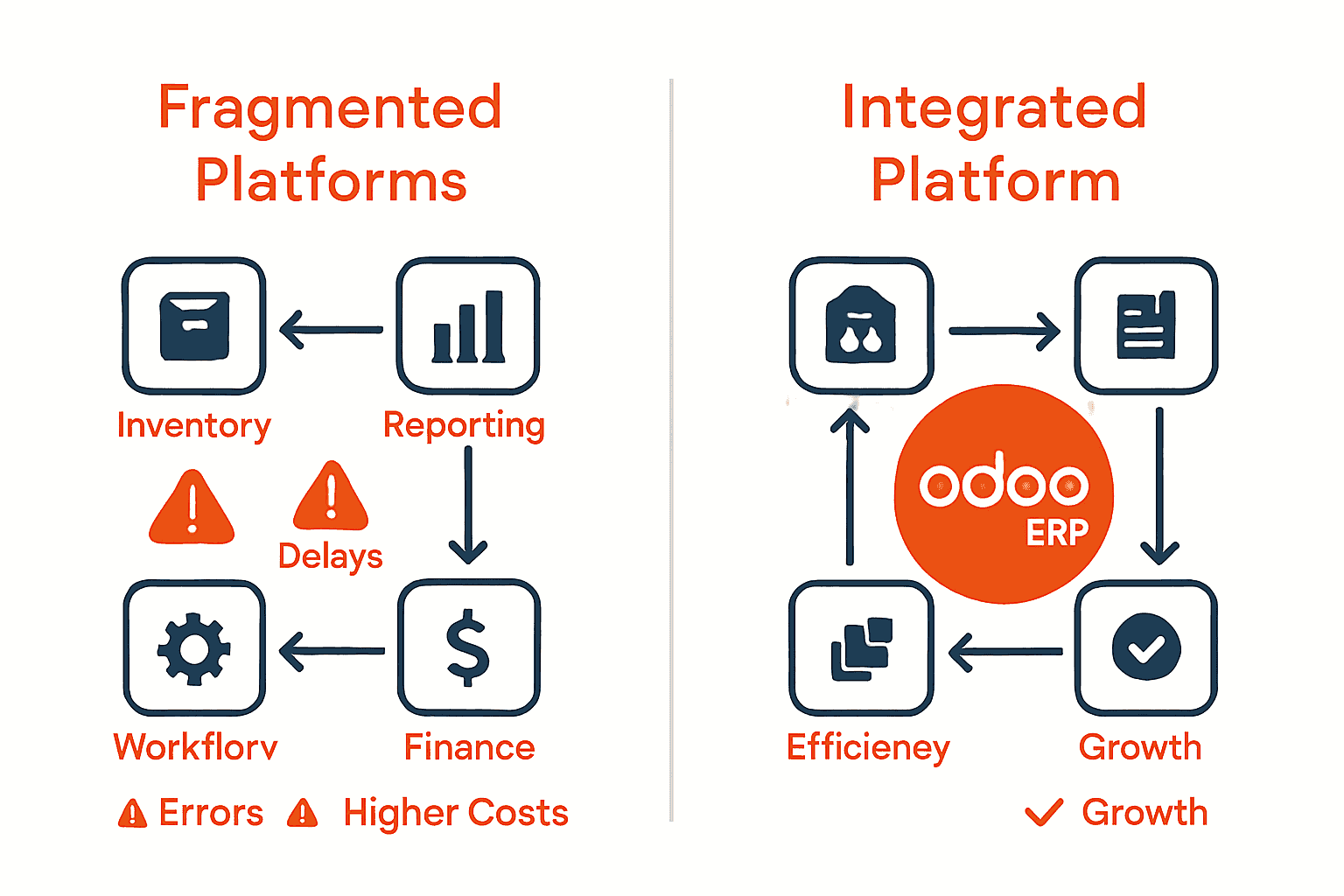
More than 80 percent of American retailers struggle with fragmented inventory and inconsistent data, costing them both time and revenue. Managing business processes across separate platforms leaves staff chasing details and increases risk. Streamlined solutions like Odoo ERP are quickly becoming vital for retailers who need unified control over operations, data, and growth in a fiercely competitive market. Discover how a modern integrated approach can help American businesses overcome chaos and thrive.
Table of Contents
- Defining Odoo ERP And Retail Operations
- Inventory Control Problems Without Centralization
- Inconsistent Data And Fragmented Reporting Risks
- Manual Workflow Inefficiencies Impacting Growth
- Financial Tracking And Compliance Challenges
Key Takeaways
| Point | Details |
|---|---|
| Odoo ERP Integration | Odoo ERP unifies multiple business processes, leading to improved efficiency and informed decision-making for retail operations. |
| Decentralized Inventory Risks | Without centralized inventory management, businesses face stock tracking challenges, increasing operational costs, and customer dissatisfaction. |
| Fragmented Reporting Issues | Inconsistent data across systems can lead to inaccurate reporting and compromised decision-making, necessitating a unified reporting system. |
| Manual Workflow Inefficiencies | Manual processes hinder scalability and create errors, making automation a critical consideration for improving productivity and operational performance. |
Defining Odoo ERP and Retail Operations
Odoo ERP represents a comprehensive business management software suite designed to transform how retail operations function. At its core, this powerful platform integrates multiple business processes into a single, streamlined system that enables companies to manage complex workflows with remarkable efficiency.
The software encompasses a wide range of modules critical for modern retail management, including sales management, inventory tracking, customer relationship management, and point of sale systems. Retailers can leverage these integrated tools to gain real-time insights into their operational performance, reduce manual data entry, and make more informed strategic decisions.
Unlike traditional enterprise resource planning systems, Odoo offers a modular architecture that allows businesses to customize their solution precisely. Retailers can start with basic functionalities and progressively add more advanced features as their operational complexity grows. Whether managing a single storefront or a multi-location retail enterprise, Odoo provides scalable solutions that adapt to unique business requirements.
Key advantages of Odoo for retail operations include:
- Unified platform for managing sales, inventory, and customer data
- Real-time reporting and analytics
- Seamless integration between different business processes
- Customizable modules tailored to specific retail needs
- Cost-effective alternative to traditional enterprise software
By consolidating disparate systems into one intelligent platform, Odoo empowers retailers to streamline operations, reduce operational costs, and create more responsive, data-driven business strategies.
Inventory Control Problems Without Centralization
Decentralized inventory management creates a complex web of operational challenges that can cripple retail and manufacturing businesses. Without a unified system, companies struggle with fragmented data, inconsistent tracking, and significant financial risks that emerge from disconnected inventory processes.
When inventory control remains scattered across multiple systems or departments, businesses encounter critical problems. Tracking stock levels becomes nearly impossible, leading to frequent stockouts or expensive overstocking scenarios. These inefficiencies directly impact customer satisfaction and organizational profitability. Vendor lead time calculations become exponentially more complicated when data exists in siloed systems, making accurate demand forecasting a significant challenge.
The fundamental issues of decentralized inventory management manifest in several key areas:
- Inconsistent data across different departments
- Inability to track real-time stock levels
- Higher risk of human error in manual inventory tracking
- Increased operational costs due to inefficient processes
- Limited visibility into overall inventory performance
Small to medium-sized businesses are particularly vulnerable to these inventory control challenges.
 Without an integrated system, financial discrepancies can quickly accumulate, creating long-term operational inefficiencies that erode competitive advantage. Implementing a centralized inventory management solution becomes not just a technological upgrade, but a critical strategic imperative for sustainable business growth.
Inconsistent Data And Fragmented Reporting Risks
Fragmented reporting systems represent a critical vulnerability for businesses attempting to maintain accurate operational insights. When data exists across multiple disconnected platforms, organizations create a dangerous environment where decision-makers rely on incomplete or contradictory information that can dramatically undermine strategic planning and financial performance.
The consequences of inconsistent data extend far beyond simple administrative inconvenience. Different departments may maintain separate records with conflicting information, leading to significant discrepancies in financial reporting, inventory tracking, and customer relationship management. These data inconsistencies create a cascade of potential errors that can result in misguided business strategies, financial misstatements, and reduced operational efficiency.
Key risks associated with fragmented reporting include:
- Inability to generate comprehensive, accurate reports
- Increased likelihood of financial discrepancies
- Compromised decision-making capabilities
- Higher administrative overhead for data reconciliation
- Reduced transparency across organizational departments
Businesses without a centralized reporting system often find themselves trapped in a cycle of manual data verification and cross-referencing. Sales management processes become exponentially more complex when information is scattered, requiring significant human intervention to maintain even basic operational coherence. The time and resources devoted to managing these fragmented systems represent a substantial hidden cost that can erode competitive advantage and prevent meaningful strategic growth.
Manual Workflow Inefficiencies Impacting Growth
Manual workflow management represents a significant barrier to business scalability, creating a labyrinth of inefficiencies that slowly erode organizational productivity and competitive potential. Small to medium-sized businesses frequently find themselves trapped in a cycle of time-consuming, error-prone processes that consume valuable resources and prevent meaningful strategic development.
The hidden costs of manual workflows extend far beyond simple time waste. Each manual task introduces multiple potential points of human error, from data entry mistakes to miscommunication between departments. These inefficiencies compound rapidly, creating a domino effect that can significantly impede business growth and operational responsiveness. Getting the most from workflow management systems becomes critical for businesses seeking to break free from these operational constraints.
Key challenges associated with manual workflow processes include:
- Excessive time spent on repetitive administrative tasks
- Higher probability of data entry errors
- Reduced ability to scale operations quickly
- Increased operational costs
- Limited visibility into process performance
- Slower decision-making capabilities
Businesses trapped in manual workflow cycles often experience a profound productivity ceiling. Each hour spent on manual data entry, reconciliation, and cross-departmental communication represents a direct opportunity cost. By transitioning to automated, integrated systems, organizations can reallocate human resources toward strategic initiatives that drive genuine business growth and innovation, transforming operational inefficiencies into competitive advantages.
Financial Tracking And Compliance Challenges
Financial complexity emerges as a critical vulnerability for businesses operating without integrated enterprise resource planning systems. Small to medium-sized organizations frequently find themselves navigating a treacherous landscape of financial tracking challenges that can expose them to significant regulatory risks and potential financial mismanagement.
Without a centralized financial management system, businesses struggle to maintain accurate, real-time financial records that meet increasingly stringent regulatory requirements. The manual processes of tracking expenses, reconciling accounts, and generating comprehensive financial reports become exponentially more complicated, creating multiple potential points of error and compliance vulnerability. Odoo accounting features provide a crucial solution to these intricate financial management challenges.
Key financial tracking and compliance challenges include:
- Difficulty maintaining accurate financial records
- Increased risk of regulatory non-compliance
- Higher likelihood of accounting errors
- Challenges in generating comprehensive financial reports
- Limited visibility into financial performance
- Reduced ability to make data-driven financial decisions
The consequences of inadequate financial tracking extend far beyond simple administrative inconvenience.
Each manual reconciliation, each spreadsheet correction, and each potential compliance misstep represents a direct threat to organizational financial health. By implementing an integrated financial management system, businesses can transform these challenges into opportunities for strategic financial oversight, ensuring accuracy, transparency, and regulatory compliance across all financial operations.
Overcome Operational Challenges with Expert Odoo ERP Implementation
The article highlights critical operational challenges such as decentralized inventory control, fragmented reporting, manual workflow inefficiencies, and financial tracking complexities. These issues can create costly delays and obscure valuable insights that stunt business growth. If your retail or manufacturing operations are struggling with inconsistent data, inefficient processes, or compliance risks, these pain points demand an effective, integrated solution tailored to your unique needs.
Bista Solutions, North America’s largest Odoo ERP implementer and a trusted Odoo Gold Partner, specializes in transforming fragmented workflows into unified, scalable systems. With over 350 successful ERP implementations and 300+ expert consultants, we deliver customized solutions that streamline sales, inventory, and financial management. Our team supports your business 24/7, ensuring smooth adoption and operational success.
Schedule A Free Odoo ERP Demo
Ready to turn your operational challenges into competitive advantages? Contact Bista Solutions now to explore tailored Odoo ERP solutions for your business. Learn how our expertise can create seamless workflows and real-time reporting that drive growth and compliance. Don’t let manual inefficiencies and fragmented data hold you back. Take action today to secure your future.
Frequently Asked Questions
What are the main challenges of decentralized inventory management?
Decentralized inventory management leads to inconsistent data across departments, difficulty in tracking real-time stock levels, higher human error risk, increased operational costs, and limited visibility into overall inventory performance.
How does fragmented data impact business decision-making?
Fragmented data creates a reliance on incomplete or contradictory information, leading to discrepancies in financial reporting, inventory tracking, and customer relationship management, which can undermine strategic planning and operational efficiency.
What inefficiencies are associated with manual workflow management?
Manual workflow management introduces excessive time spent on repetitive tasks, a higher probability of errors, reduced scalability, increased operational costs, limited visibility into process performance, and slower decision-making capabilities.
Why is integrated financial management important for businesses?
Integrated financial management ensures accurate, real-time financial records, reduces the risk of regulatory non-compliance and accounting errors, improves the ability to generate comprehensive financial reports, and enhances data-driven financial decision-making.
