

Understanding Odoo Accounting vs. QuickBooks – Why Upgrade?
by Uzlifat Mir
- Sep 09, 2025
- 0
- Category: Odoo Migration
Businesses are always searching for smarter ways to handle their finances. Sure, most people think QuickBooks is the king of small business accounting, handling over 80 percent of the US market for financial software. But what if the real power move is switching to something that connects every part of your business, not just your books? Odoo does exactly that, rewriting what companies can expect from their software—and it’s changing the game for businesses ready to scale.
Table of Contents
- What Are Odoo Accounting And QuickBooks?
- Why Do Businesses Choose Odoo Erp Over Quickbooks?
- How Odoo Erp Enhances Business Financial Management
- Key Features Of Odoo That Stand Out Against Quickbooks
- Real-World Success Stories Of Businesses Upgrading To Odoo
Quick Summary
| Takeaway | Explanation |
|---|---|
| Odoo offers greater scalability than QuickBooks | Odoo’s open-source approach allows businesses to expand functionalities as they grow without significant additional investment. |
| Integrated modules enhance operational efficiency | Odoo connects accounting with sales, inventory, and more, eliminating manual data transfer and improving real-time performance tracking. |
| Customization is a key advantage of Odoo | With its flexible architecture, Odoo can be tailored to fit unique business workflows, allowing organizations to adapt the software easily. |
| Odoo provides advanced financial reporting capabilities | Real-time reporting and customizable dashboards in Odoo help businesses analyze financial data across multiple departments effectively. |
| Automation minimizes manual errors in financial processes | Odoo streamlines workflows with features like automated invoice generation, reducing human error and improving efficiency in financial operations. |
What Are Odoo Accounting and QuickBooks?
In the evolving landscape of business management software, two prominent solutions stand out: Odoo Accounting and QuickBooks. These platforms represent different approaches to financial management, each designed to help businesses track, manage, and optimize their financial operations.
Understanding Odoo Accounting
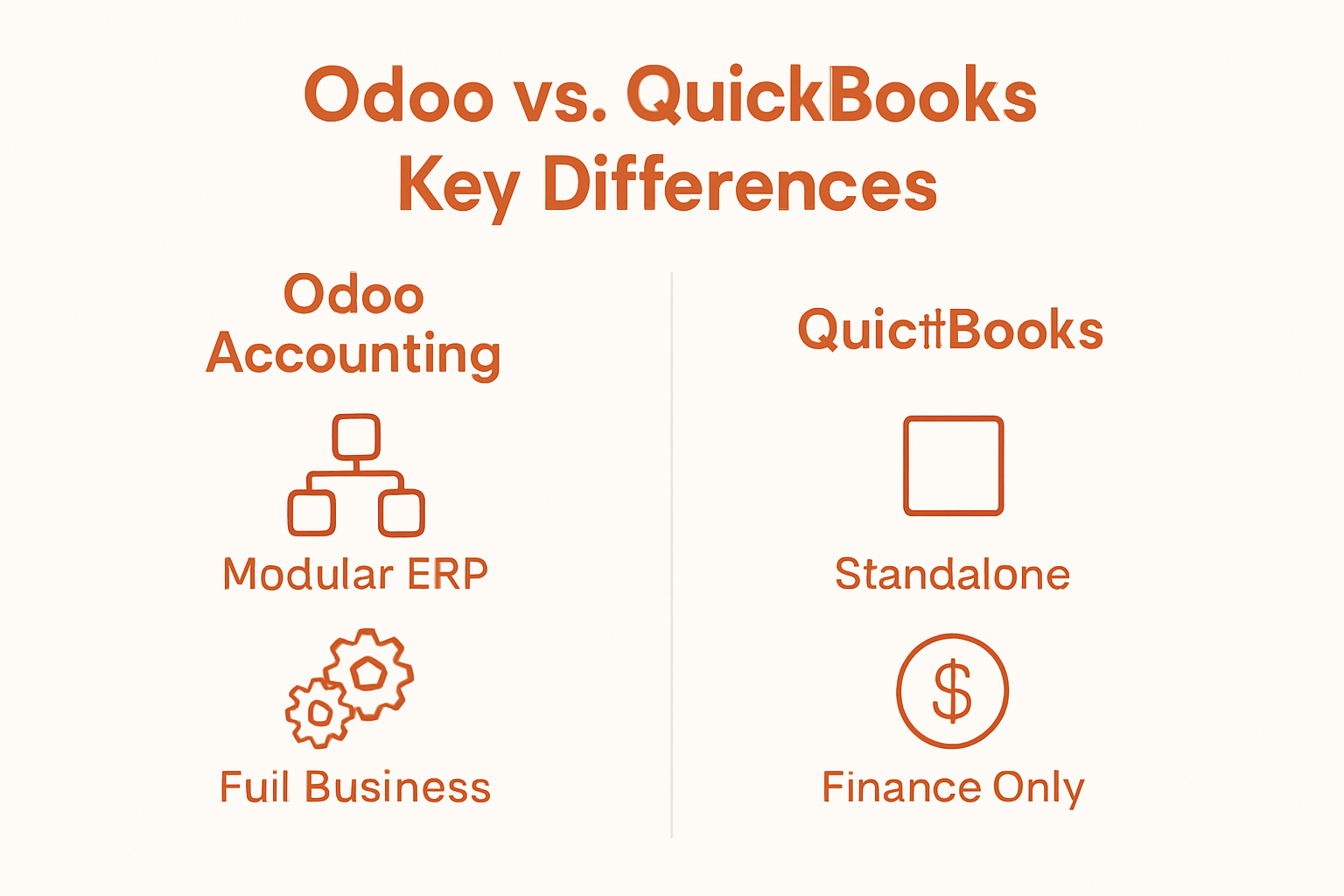
Odoo Accounting is a comprehensive business management suite that goes far beyond traditional accounting software. As an open-source platform, it offers businesses unprecedented flexibility and integration capabilities. Unlike standalone accounting tools, Odoo provides a holistic approach by seamlessly connecting accounting functions with other critical business processes like sales, inventory, human resources, and customer relationship management.
Key characteristics of Odoo Accounting include:
- Fully customizable and adaptable to unique business requirements
- Cloud-based and accessible from multiple devices
- Integrated with other business management modules
- Supports multiple currencies and international accounting standards
Comparing QuickBooks and Odoo
QuickBooks, developed by Intuit, represents a more traditional accounting software approach. It primarily focuses on financial record keeping, invoicing, payroll, and tax preparation. While powerful in its domain, QuickBooks typically operates as a standalone solution with limited integration capabilities compared to Odoo’s comprehensive ecosystem.
Businesses considering these platforms must evaluate their specific needs. Odoo offers unparalleled flexibility and scalability, making it an attractive option for growing companies that require a dynamic, integrated business management solution. Learn more about Odoo accounting advantages and how it can transform your financial management approach.
Whether you are a small startup or a large enterprise, understanding the nuanced differences between these platforms is crucial for making an informed technology investment that aligns with your business strategy and growth objectives.
To clarify the differences between Odoo Accounting and QuickBooks, the table below compares their core approaches, flexibility, scalability, and suitability for different business needs.
| Feature / Aspect | Odoo Accounting | QuickBooks |
|---|---|---|
| Platform Type | Open-source ERP suite | Traditional standalone accounting software |
| Integration Capabilities | Connects accounting with sales, inventory, HR, etc. | Limited, mainly focused on accounting |
| Customization | Highly customizable for unique workflows | Limited customization |
| Scalability | Suitable for startups to large enterprises | Primarily for small to mid-sized businesses |
| Reporting & Analytics | Advanced, cross-department real-time analytics | Standard accounting reports |
| Cost Structure | Modular; cost-effective for growth | Pricing grows with added features |
| Accessibility | Cloud-based, multi-device | Cloud and desktop versions available |
Why Do Businesses Choose Odoo ERP Over QuickBooks?
Businesses are increasingly migrating from traditional accounting software like QuickBooks to comprehensive ERP solutions like Odoo, driven by evolving technological needs and strategic growth objectives. Understanding the core motivations behind this transition reveals critical advantages that make Odoo an attractive alternative.
Scalability and Comprehensive Integration
One of the primary reasons businesses upgrade to Odoo is its unparalleled scalability and seamless integration capabilities. Unlike QuickBooks, which functions primarily as an accounting tool, Odoo provides a holistic business management ecosystem. This means companies can effortlessly connect accounting with sales, inventory, human resources, customer relationship management, and other critical business functions within a single platform.
Key integration benefits include:
- Real-time data synchronization across multiple departments
- Elimination of manual data entry and potential errors
- Centralized information management
- Comprehensive reporting and analytics
Cost-Effectiveness and Customization
Odoo stands out as a more cost-effective solution compared to QuickBooks, especially for growing businesses. Its open-source architecture allows for extensive customization without significant additional expenses. Small and medium-sized enterprises can start with essential modules and progressively expand their system as their business requirements evolve.
Flexibility is a hallmark of Odoo’s design, enabling businesses to adapt the software to their unique operational workflows rather than modifying their processes to fit rigid software constraints. Explore our detailed guide on Odoo accounting advantages to understand how this adaptability translates into tangible business benefits.
Businesses seeking a robust, future-proof solution that grows alongside their organizational needs will find Odoo a compelling alternative to traditional accounting software. The platform not only addresses current financial management requirements but also provides a strategic technology foundation for long-term business success.
How Odoo ERP Enhances Business Financial Management
Odoo ERP transforms financial management by providing businesses with a sophisticated, integrated approach to tracking, analyzing, and optimizing financial operations. Unlike traditional accounting software, Odoo delivers a comprehensive solution that goes beyond simple bookkeeping to become a strategic business intelligence tool.
Advanced Financial Reporting and Analytics
Real-time financial insights are the cornerstone of effective business decision-making. Odoo ERP empowers organizations with dynamic reporting capabilities that synthesize data across multiple business functions. This holistic approach enables financial leaders to generate comprehensive reports that reveal intricate connections between financial performance and operational activities.
Key reporting features include:
- Customizable dashboards with interactive financial visualizations
- Automated generation of complex financial statements
- Multi-currency and multi-company reporting capabilities
- Detailed drill-down analysis for granular financial examination
Streamlined Financial Processes
Odoo eliminates traditional inefficiencies by automating critical financial workflows. The platform reduces manual data entry, minimizes human error, and accelerates financial close processes. Intelligent automation means finance teams can shift from repetitive administrative tasks to strategic financial planning and analysis.
Businesses gain unprecedented operational efficiency through features like automatic invoice generation, seamless bank reconciliation, and integrated payment processing. Discover our comprehensive guide to Odoo accounting features to understand how these technologies can revolutionize your financial management approach.
By providing a unified platform that connects accounting with sales, inventory, procurement, and other critical business functions, Odoo ERP ensures that financial data remains consistently accurate and immediately accessible.
The table below highlights key integration and automation features that distinguish Odoo ERP from traditional accounting software, enabling businesses to achieve greater efficiency and strategic insight.
| Key Feature | Odoo ERP Benefit | Impact on Business Operations |
|---|---|---|
| Module Integration | Connects accounting, sales, inventory, HR, and CRM | Eliminates manual data transfer |
| Real-Time Data Synchronization | Updates are shared across departments instantly | Enables accurate and timely decisions |
| Automated Workflows | Automates invoicing, reconciliation, and reporting | Reduces manual work and errors |
| Customizable Dashboards | Visualizes financial and operational data in real time | Supports strategic planning |
| Multi-Currency/Company Support | Handles global financial needs | Expands operations without technical barriers |
| Scalability | Adds new modules as business grows | Future-proof technology investments |
Key Features of Odoo That Stand Out Against QuickBooks
Odoo ERP represents a quantum leap in business management technology, offering capabilities that far surpass traditional accounting software like QuickBooks. By providing a comprehensive, integrated platform, Odoo delivers features that transform how businesses manage their financial and operational ecosystems.
Comprehensive Business Module Integration
Seamless cross-functional integration is Odoo’s most distinctive advantage. Unlike QuickBooks, which remains primarily an accounting tool, Odoo offers a unified platform where accounting dynamically connects with sales, inventory, human resources, customer relationship management, and other critical business functions.
Key integrated module advantages include:
- Automatic synchronization of financial data across departments
- Real-time performance tracking and reporting
- Elimination of manual data transfer between systems
- Holistic business intelligence and decision-making support
Customization and Scalability
Odoo’s open-source architecture provides unprecedented flexibility that QuickBooks cannot match. Businesses can customize the platform to precisely match their unique operational workflows, adding or modifying modules as their organizational needs evolve. Scalability becomes a strategic advantage, allowing companies to start with essential functionalities and progressively expand their system without significant additional investment.
Explore our comprehensive guide to Odoo’s modular capabilities to understand how this adaptability translates into tangible business growth opportunities.
From small startups to large enterprises, Odoo offers a powerful, adaptable solution that grows alongside your business. By transcending the limitations of traditional accounting software, Odoo empowers organizations to transform financial management from a routine administrative task into a strategic competitive advantage.
Real-World Success Stories of Businesses Upgrading to Odoo
Businesses across various industries have discovered transformative potential by migrating from traditional accounting software to Odoo ERP. These success stories illustrate how a comprehensive, integrated platform can revolutionize operational efficiency and strategic decision making.
Manufacturing Sector Transformation
Operational complexity demands sophisticated solutions, and one mid-sized manufacturing company demonstrated this perfectly. By implementing Odoo, they integrated production planning, inventory management, and financial tracking into a single, cohesive system. The result was a 40% reduction in administrative overhead and real-time visibility into production costs and profitability.

Key operational improvements included:
- Automated inventory tracking across multiple warehouses
- Seamless integration between production scheduling and financial reporting
- Reduced manual data entry and associated errors
- Enhanced forecasting capabilities
Retail and E-Commerce Evolution
A growing e-commerce retailer faced significant challenges with disconnected systems that made tracking sales, inventory, and financial performance challenging. Odoo’s modular approach provided a game-changing solution, enabling them to connect their online sales platforms, physical store operations, and accounting functions into one unified ecosystem.
Discover how businesses are revolutionizing their operations with Odoo and learn from real-world implementation strategies that drive tangible business growth.
These success stories underscore a critical insight: upgrading to Odoo is not just about changing software, but fundamentally transforming how businesses operate. By providing a flexible, integrated platform that adapts to unique organizational needs, Odoo empowers companies to move beyond traditional limitations and unlock unprecedented operational potential.
Ready to Experience a True Upgrade Beyond Basic Accounting?
Are you tired of software that limits your potential? This article highlights how moving from isolated tools like QuickBooks to integrated solutions like Odoo can transform financial management, streamline processes, and fuel real business growth. Many businesses reach a critical point where manual work, disconnected data, and a lack of real-time insight hold them back. If you recognize these challenges, it is time to consider a smarter, more adaptable platform.
Bista Solutions is the trusted partner behind more than 350 successful Odoo ERP implementations. As the largest Odoo Gold Partner in North America and a multi-year winner of the Odoo Best Partner award, we know what it takes to create a seamless and scalable ERP transition. Take the first step toward a fully integrated business future by connecting with our expert team today. Discover your custom roadmap and see how modern ERP, tailored for your needs, can make a measurable difference. Contact us now through our main website and start your journey to smarter business management.
Frequently Asked Questions
What is the main difference between Odoo Accounting and QuickBooks?
Odoo Accounting is a comprehensive business management suite that integrates accounting with other business functions like sales and inventory, whereas QuickBooks primarily focuses on standalone accounting tasks like invoicing and payroll.
Why should businesses consider upgrading from QuickBooks to Odoo?
Businesses may upgrade to Odoo for its scalability, comprehensive integration capabilities, cost-effectiveness, and customization options that adapt to unique operational needs, providing a more holistic management solution.
How does Odoo ERP improve financial reporting compared to QuickBooks?
Odoo ERP offers advanced reporting features, including customizable dashboards, real-time financial insights, and multi-currency reporting, allowing businesses to analyze financial data within the context of their broader operations.
Can Odoo Accounting be customized to fit my unique business needs?
Yes, Odoo Accounting is highly customizable thanks to its open-source architecture, enabling businesses to adapt the software with specific modules and functionalities that match their operational workflows.
