

Odoo for Discrete Manufacturing: Driving Efficiency

by Uzlifat Mir
- Mar 17, 2026
- 0
- Category: Manufacturing Industry
Over half of American mid-sized manufacturers cite production inefficiency as a top barrier to growth. Electronics and automotive businesses across the United States face increasing pressure to deliver precision, traceability, and compliance in today’s competitive landscape. Discover how Odoo’s scalable ERP framework helps American manufacturers tackle discrete production challenges, giving them the control and insight needed to optimize every phase of operations.
Table of Contents
- Discrete Manufacturing With Odoo: Core Concepts
- Key Components: Electronics Versus Automotive
- How Odoo Transforms Production Workflows
- Scalability, Compliance, And Integration Essentials
- Cost, Risk, And Common Implementation Pitfalls
Key Takeaways
| Point | Details |
|---|---|
| Discrete Manufacturing Definition | Discrete manufacturing creates distinct, countable products through sequential processes, focusing on identifiable units such as electronics and automotive components. |
| Odoo ERP Benefits | Odoo provides comprehensive modules for managing production workflows, enabling precise tracking, quality control, and real-time analytics tailored to manufacturing needs. |
| Industry-Specific Challenges | Electronics and automotive manufacturing have unique production workflows, requiring different ERP configurations to address their specific tracking and quality assurance needs. |
| Implementation Considerations | A successful ERP implementation necessitates careful planning for costs, user training, and organizational readiness to avoid common pitfalls and ensure alignment with business objectives. |
Discrete Manufacturing With Odoo: Core Concepts
Discrete manufacturing represents a complex production approach where distinct, countable products are created through sequential processes. Unlike process manufacturing that produces bulk materials, discrete manufacturing focuses on creating individual, identifiable units like electronics, automotive parts, and machinery components. Odoo Manufacturing ERP Solution provides a comprehensive framework designed specifically to address the unique challenges of these specialized production environments.
The core characteristics of discrete manufacturing involve breaking down production into specific work orders, managing precise component tracking, and maintaining strict quality control protocols. Odoo supports these requirements through robust modules that enable manufacturers to track each product’s journey from raw materials to finished goods. Key functionalities include work order management, inventory control, bill of materials tracking, and real-time production analytics that give manufacturers granular visibility into their entire production ecosystem.
Odoo’s manufacturing modules are strategically designed to address complex discrete manufacturing workflows. The platform provides powerful tools for managing production planning, scheduling, quality checks, and inventory management. Manufacturers can create detailed work center configurations, define routing for complex product assemblies, and implement multi-step quality verification processes. These capabilities ensure that each discrete product meets exact specifications while maintaining optimal production efficiency.
Pro tip: When implementing Odoo for discrete manufacturing, start by mapping your current production workflows and identifying specific customization needs before configuration to maximize system alignment with your operational requirements.
Key Components: Electronics Versus Automotive
Electronics and automotive manufacturing represent two distinct domains of discrete manufacturing, each with unique production challenges that demand specialized ERP approaches. Electronic repair ERP highlights the intricate requirements specific to electronics production, which typically involve highly sensitive component handling, precision assembly, and complex quality verification processes. Automotive manufacturing, by contrast, focuses on large-scale production with extensive supply chain integration and stringent regulatory compliance.
The production workflows in electronics manufacturing are characterized by microscopic precision, intricate circuit board assembly, and rapid technological iterations. Key components include surface mount technology (SMT) lines, component testing stations, and specialized inventory management for sensitive electronic parts. Automotive manufacturing, however, emphasizes modular assembly, extensive mechanical engineering, and integration of multiple subsystems like drivetrain, electrical systems, and structural components. These fundamental differences require nuanced ERP configurations that can adapt to each industry’s specific operational rhythms.
When examining component tracking and traceability, electronics manufacturers typically require granular lot and serial number tracking due to the high-value and sensitive nature of electronic components. Automotive manufacturers focus more on batch-level tracking, component genealogy for safety compliance, and comprehensive work order management across complex assembly lines. Odoo’s flexible manufacturing modules provide the adaptability needed to configure unique workflows for both sectors, enabling manufacturers to implement industry-specific quality control protocols, inventory management strategies, and production tracking mechanisms.

Here’s how discrete manufacturing in electronics compares to automotive industries:
| Aspect | Electronics Manufacturing | Automotive Manufacturing |
|---|---|---|
| Precision Requirements | Microscopic component alignment | Large-scale mechanical assembly |
| Tracking Focus | Lot and serial number tracking | Batch tracking and genealogy |
| Quality Control | Complex, multi-step verification | Safety compliance protocols |
| Production Scale | High product variety, short runs | Large volumes, long production |
| Inventory Needs | Sensitive parts, specialized storage | Modular parts, supply chain depth |
Pro tip: Develop separate configuration templates for electronics and automotive manufacturing workflows within your Odoo ERP implementation to ensure precise alignment with each industry’s unique operational requirements.
How Odoo Transforms Production Workflows
Odoo fundamentally reimagines production management through its sophisticated manufacturing modules, enabling manufacturers to streamline complex operational processes with unprecedented flexibility. Odoo Production Planning & Scheduling ERP demonstrates how advanced digital tools can revolutionize traditional manufacturing workflows by integrating multiple critical functions into a seamless, intelligent system. The platform transforms disconnected production activities into a cohesive, data-driven ecosystem that adapts dynamically to changing manufacturing requirements.
The transformation begins with intelligent workflow configuration that allows manufacturers to create custom production routes, define precise work center capabilities, and establish complex routing rules. Manufacturers can design intricate production processes that automatically route work orders, manage capacity planning, and track real-time resource utilization. Key workflow transformation features include automated scheduling algorithms, comprehensive resource allocation tools, and dynamic production tracking mechanisms that provide granular visibility into every stage of the manufacturing process.
By leveraging advanced manufacturing execution system integrations, Odoo enables manufacturers to transcend traditional operational limitations. The platform supports comprehensive quality management protocols, predictive maintenance scheduling, and instantaneous performance analytics. Manufacturers can implement multi-level quality checks, track equipment performance, and generate detailed reports that provide actionable insights into production efficiency, bottlenecks, and potential optimization opportunities. These capabilities represent a quantum leap beyond traditional manufacturing management approaches, empowering businesses to make data-driven decisions with unprecedented speed and accuracy.
Pro tip: When implementing Odoo’s manufacturing workflows, start by mapping your existing processes comprehensively and identifying potential automation opportunities to maximize system effectiveness and operational efficiency.
Scalability, Compliance, and Integration Essentials
Discrete manufacturing organizations require sophisticated ERP solutions that can seamlessly adapt to evolving business requirements while maintaining rigorous compliance standards. ERP implementation represents a critical strategic initiative that determines an organization’s ability to scale operations, integrate complex workflows, and meet increasingly stringent regulatory requirements across multiple industries.
Scalability in manufacturing ERP systems demands a flexible architecture that can accommodate dynamic business growth, varying production volumes, and complex operational configurations. Odoo’s modular design enables manufacturers to incrementally expand their technological infrastructure, adding new functionalities, connecting additional production lines, and integrating emerging technologies without disrupting existing workflows. This approach allows businesses to implement sophisticated manufacturing capabilities in stages, minimizing implementation risks and aligning technological investments with strategic business objectives.
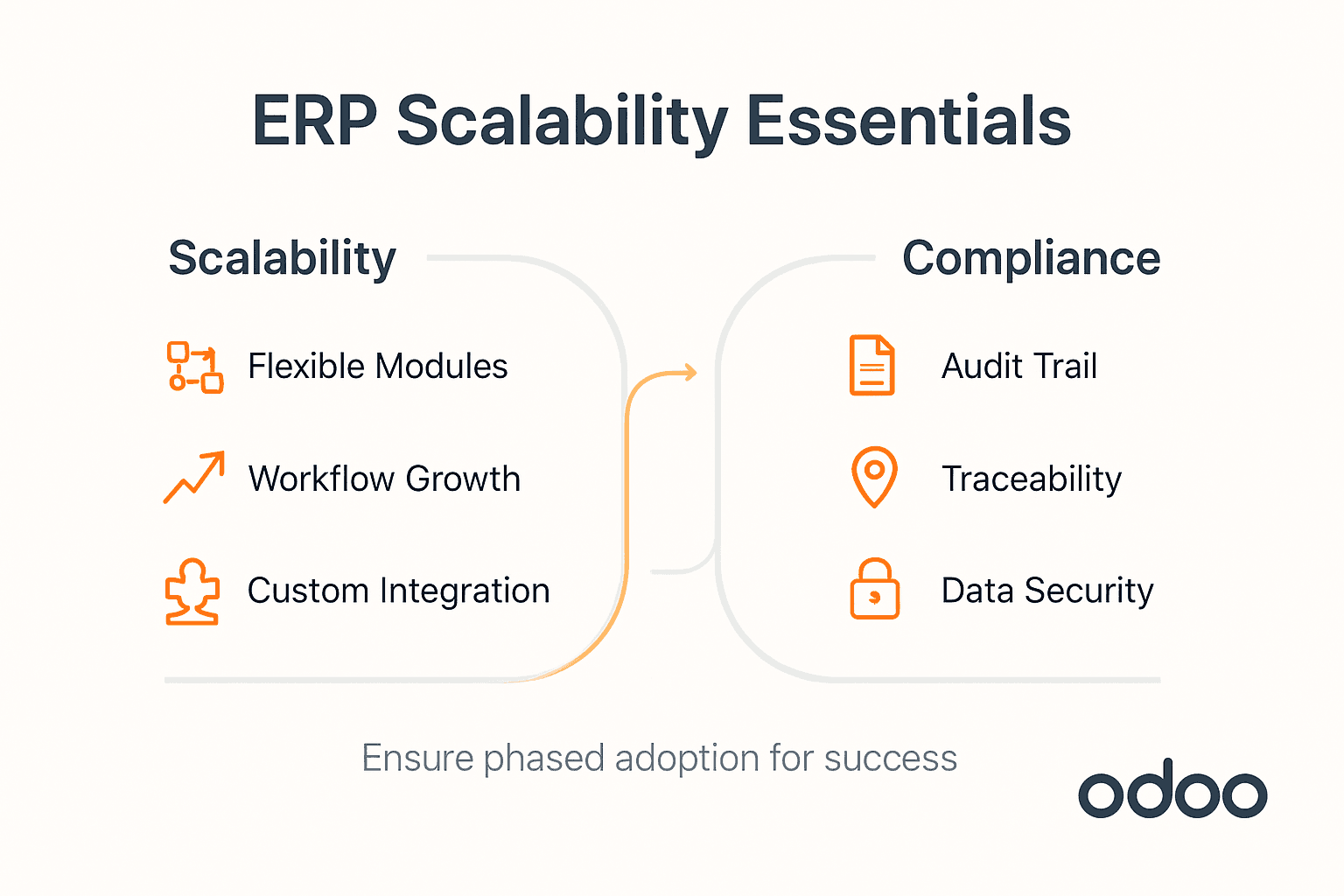
Compliance and integration represent two critical dimensions of modern manufacturing technology infrastructure. Advanced manufacturing organizations must navigate complex regulatory landscapes that vary significantly across industries, requiring ERP systems capable of implementing precise quality control protocols, maintaining comprehensive audit trails, and generating detailed compliance documentation. Odoo’s manufacturing modules provide granular tracking mechanisms, automated reporting tools, and configurable workflow controls that enable manufacturers to demonstrate regulatory adherence while maintaining operational efficiency. The platform’s robust integration capabilities allow seamless connections between manufacturing execution systems, enterprise resource planning modules, supply chain management tools, and financial reporting systems, creating a unified technological ecosystem.
Pro tip: Develop a phased implementation strategy that prioritizes core manufacturing workflows and compliance requirements, allowing for incremental system expansion and continuous technological optimization.
Cost, Risk, and Common Implementation Pitfalls
Implementing an Enterprise Resource Planning (ERP) system for discrete manufacturing represents a complex strategic investment that requires careful financial planning and risk mitigation. What is ERP implementation reveals the multifaceted challenges organizations encounter when transitioning to advanced technological platforms, highlighting the critical importance of understanding potential financial and operational risks before embarking on a comprehensive ERP transformation.
The financial landscape of ERP implementation involves several nuanced cost considerations beyond initial software licensing. Manufacturers must account for direct expenses such as software procurement, hardware infrastructure upgrades, and implementation consulting fees, as well as indirect costs including employee training, potential productivity disruptions during system transition, and ongoing maintenance requirements. Typical implementation costs can range from 1.5 to 3 times the initial software investment, emphasizing the need for comprehensive budgetary planning and rigorous vendor selection processes that align technological capabilities with specific organizational requirements.
Below is a summary of common ERP implementation cost elements and associated risks:
| Cost Element | Description | Key Risk Factor |
|---|---|---|
| Software Licensing | Upfront and recurring software fees | Underestimating long-term expenses |
| Hardware Upgrades | Infrastructure upgrades and maintenance | Overlooked compatibility issues |
| Consulting/Customization | External setup and process alignment | Misalignment with business processes |
| Training & Change Mgmt | Staff training and adoption resources | Insufficient user adoption |
| Ongoing Maintenance | Updates, support, and improvements | Delays in addressing system needs |
Common implementation pitfalls in discrete manufacturing ERP deployments often stem from inadequate preparation, unrealistic expectations, and insufficient organizational change management. Critical risks include data migration challenges, insufficient user training, lack of executive sponsorship, and failure to customize the system to match unique manufacturing workflows. Successful implementations require a holistic approach that combines technological expertise with strategic organizational alignment, ensuring that the ERP platform not only meets technical specifications but also effectively supports the broader operational and strategic objectives of the manufacturing organization.
Pro tip: Conduct a comprehensive organizational readiness assessment and develop a detailed implementation roadmap that includes clear milestones, stakeholder engagement strategies, and contingency planning to mitigate potential risks during ERP system deployment.
Unlock the Full Potential of Discrete Manufacturing with Expert Odoo Implementation
Discrete manufacturing demands precision, flexibility, and robust quality control to manage complex production workflows effectively. If you are facing challenges like detailed component tracking, multi-step quality validation, or optimizing production scheduling, you are not alone. This article highlights how Odoo’s manufacturing modules can transform your operations, but successful adoption requires tailored ERP solutions aligned to your unique workflows and industry needs.
At Bista Solutions, we specialize in delivering scalable Odoo ERP implementations designed to meet the specific requirements of discrete manufacturing in electronics, automotive, and beyond. With over 350 successful ERP deployments globally and recognition as the Odoo Best Partner across North America for multiple years, our experienced consultants empower you to streamline production, enhance compliance, and scale confidently.
Contact Us For A Demo
Don’t let complex manufacturing processes hold your business back. Contact our team today to discover how a customized Odoo solution can drive efficiency and precision in your discrete manufacturing operations. Visit the Bista Solutions Contact to start your transformation journey now.
Frequently Asked Questions
What is discrete manufacturing in the context of Odoo?
Discrete manufacturing refers to the production approach that creates distinct, countable products through sequential processes. Odoo provides tailored solutions to address the specific challenges faced by this manufacturing methodology.
How does Odoo support quality control in discrete manufacturing?
Odoo offers robust quality control functionalities that enable manufacturers to implement multi-step verification processes to ensure each product meets strict specifications throughout production.
What are the critical components of Odoo’s manufacturing modules for electronics and automotive production?
Odoo’s manufacturing modules cater to specific workflows of electronics and automotive production, focusing on aspects like component tracking, compliance, quality verification, and inventory management tailored to each industry’s unique needs.
What are the potential pitfalls to avoid when implementing Odoo for discrete manufacturing?
Common pitfalls include inadequate preparation for data migration, unrealistic implementation expectations, insufficient user training, and failure to align the system with specific workflows. A detailed implementation roadmap can help mitigate these risks.
