

Shopify and Complex B2B Sales: Real-World Advantages

 by Uzlifat Mir
More than 60 percent of American manufacturing companies still struggle with outdated sales processes that slow down decision making and hurt profit margins. For B2B sales managers in Texas, the pressure to compete and deliver fast, accurate quotes is greater than ever. Shopify offers a practical solution that blends advanced technology with everyday usability, helping businesses in America navigate the complexity of modern sales operations with greater efficiency.
Table of Contents
- Shopify’s Role in Modern B2B Sales
- B2B Pricing Structures and Custom Catalogs
- Automating Account Management and Workflows
- Integrating Shopify With ERP and CRM Systems
- Mitigating B2B Sales Risks and Challenges
Key Takeaways
| Point | Details |
|---|---|
| Shopify’s Transformation of B2B Sales | Shopify offers a scalable platform that supports complex sales workflows, enabling personalized customer experiences and advanced pricing options. |
| Dynamic Pricing and Custom Catalogs | Implementing flexible pricing models and tailored catalogs can significantly enhance customer engagement and meet varied purchasing needs. |
| Automation in Account Management | Utilizing intelligent automation tools streamlines account management, allowing sales teams to focus on strategic relationship-building. |
| Importance of Integration | Seamless integration of Shopify with ERP and CRM systems provides a unified view of operations, improving decision-making and operational efficiency. |
Shopify’s Role in Modern B2B Sales
B2B sales have undergone a radical transformation with digital platforms like Shopify redefining how companies approach complex sales processes. Unlike traditional sales models, modern B2B transactions require sophisticated digital infrastructure that can handle intricate customer relationships, customized pricing structures, and seamless integration across multiple business systems. Shopify has emerged as a powerful solution that addresses these nuanced requirements by providing a flexible, scalable platform designed specifically for business-to-business transactions.
The platform’s strength lies in its ability to manage complex sales workflows that extend beyond simple transactional exchanges. Research from MIT Sloan highlights Shopify’s capacity to facilitate technology enablement and data collaboration, which are critical components in modern B2B sales environments. By offering advanced features like custom pricing rules, bulk ordering capabilities, and integrated customer management tools, Shopify enables manufacturers and distributors to create more responsive and adaptive sales processes.
Key advantages of Shopify in B2B sales include:
- Personalized customer account portals
- Advanced pricing and volume discount configurations
- Seamless integration with enterprise resource planning systems
- Robust payment and credit management tools
- Sophisticated quoting and negotiation workflows
Companies leveraging Shopify can transform their sales strategies by implementing more dynamic, data-driven approaches that respond quickly to evolving market demands. The platform’s advanced eCommerce platform capabilities enable businesses to create tailored experiences that meet the complex expectations of modern B2B buyers.
Pro tip: Configure custom price lists and customer-specific catalogs to create more personalized purchasing experiences for your B2B clients.
B2B Pricing Structures and Custom Catalogs
In the complex world of B2B commerce, pricing strategies and product catalogs are far more sophisticated than traditional retail models. Custom pricing structures have become a critical differentiator for businesses seeking to create tailored experiences that meet diverse customer needs. Shopify’s advanced platform enables companies to implement dynamic pricing models that go beyond simple one-size-fits-all approaches, allowing for intricate pricing configurations that reflect the nuanced relationships in business-to-business transactions.
The research from Shopify highlights the importance of flexible pricing strategies that support multi-year agreements, tiered quotes, and negotiated rebates. Odoo Sales Management systems complement these capabilities by providing additional tools for managing complex sales workflows. B2B pricing models now require granular control, including:
- Volume-based discounts
- Customer-specific pricing tiers
- Contract-based pricing variations
- Seasonal and promotional pricing adjustments
- Bulk order pricing configurations
Custom catalogs represent another critical aspect of B2B digital commerce. Unlike B2C platforms, B2B environments demand highly specialized product visibility and access controls. Companies can now create market-specific, company-specific, and even individual customer-specific catalogs that enhance relevance and purchasing efficiency. These tailored catalogs allow businesses to manage product visibility, ensure compliance, and provide precise pricing control across different customer segments.
The integration of advanced pricing and catalog management tools transforms how companies approach B2B sales. By leveraging technology that supports complex, data-driven pricing strategies, organizations can create more responsive and personalized purchasing experiences that align with specific customer requirements and market dynamics.

Pro tip: Implement dynamic pricing rules that automatically adjust based on customer volume, historical purchasing patterns, and negotiated contract terms.
Automating Account Management and Workflows
The landscape of B2B sales is rapidly transforming through advanced automation technologies that streamline complex account management processes. Workflow automation has emerged as a critical strategy for businesses seeking to optimize their sales interactions, reduce manual administrative tasks, and create more efficient customer engagement models. By leveraging intelligent automation tools, companies can dramatically improve their operational efficiency and focus their human resources on strategic relationship-building activities.
Artificial intelligence and machine learning technologies are revolutionizing how businesses approach account management workflows. Workflow management systems now enable sophisticated automation capabilities that can handle multiple critical functions, including:
- Automatic lead qualification and scoring
- Personalized communication tracking
- Customer interaction documentation
- Scheduled follow-up processes
- Intelligent task routing and assignment
Research from the National CIO Review highlights how agentic AI technologies are transforming B2B sales workflows by anticipating tasks and personalizing communication strategies. These advanced systems can handle top-of-funnel outreach, qualify potential leads, and even schedule initial meetings, allowing sales professionals to concentrate on high-value relationship development and strategic decision-making. The result is a more responsive, efficient sales process that can adapt quickly to changing customer needs and market dynamics.
The integration of sophisticated automation tools represents a fundamental shift in how companies manage customer relationships. By reducing repetitive administrative tasks and providing intelligent insights, these technologies enable sales teams to create more meaningful, personalized interactions that drive long-term business success. Advanced workflow automation goes beyond simple task management, creating a comprehensive ecosystem that supports more strategic, data-driven sales approaches.
Pro tip: Implement a comprehensive workflow automation strategy that integrates AI-driven insights with your existing customer relationship management systems to maximize efficiency and personalization.
Integrating Shopify With ERP and CRM Systems
In the complex world of B2B sales, seamless integration between Shopify, Enterprise Resource Planning (ERP), and Customer Relationship Management (CRM) systems has become a critical competitive advantage. System integration transforms fragmented business processes into a cohesive, data-driven ecosystem that enables more intelligent decision-making and enhanced operational efficiency. By creating a unified platform, businesses can break down traditional data silos and create a more holistic view of their sales and customer interactions.
ERP implementation strategies are fundamental to achieving comprehensive business system integration. These advanced integration approaches enable real-time synchronization across multiple business functions, providing critical capabilities such as:
- Instant inventory tracking
- Automated order processing
- Centralized customer data management
- Seamless financial reporting
- Dynamic pricing and discount management
Research from IEEE highlights the transformative potential of integrating Shopify with ERP systems. By creating a central data repository that synchronizes inventory, orders, and customer information, businesses can achieve unprecedented operational visibility. This integration allows companies to move beyond traditional transaction-based interactions, developing more responsive and adaptive sales strategies that can quickly adjust to changing market conditions and customer requirements.
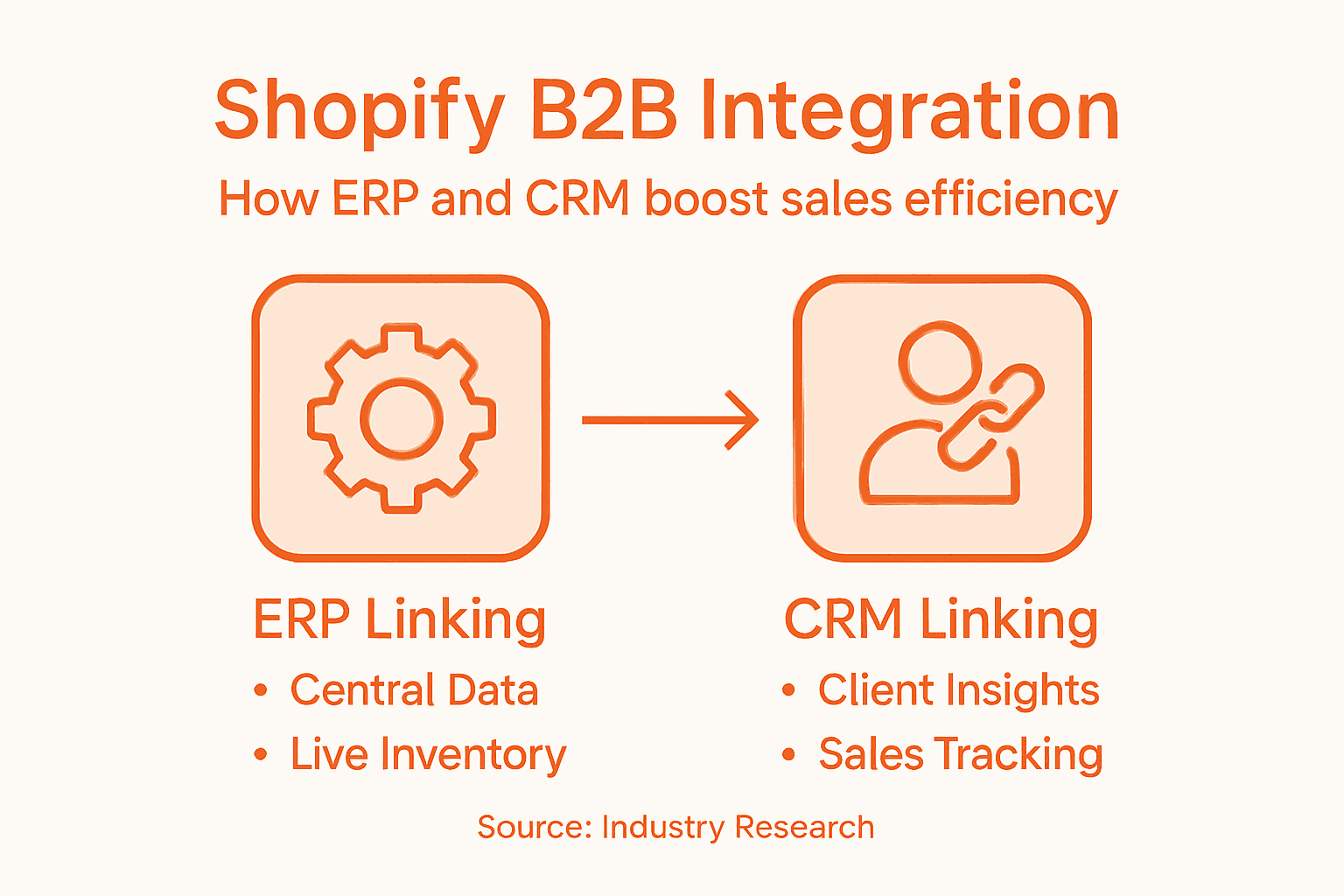
CRM integration takes these capabilities even further by enabling sophisticated customer relationship management. Through advanced data synchronization, businesses can create personalized customer journeys, track interaction histories, and develop more targeted marketing and sales approaches. The seamless flow of information between Shopify, ERP, and CRM systems enables a comprehensive understanding of customer behaviors, preferences, and potential opportunities, transforming raw data into actionable business intelligence.
Here’s a summary of key integration benefits when connecting Shopify with ERP and CRM systems:
| Integration Area | Business Impact | Example Outcome |
|---|---|---|
| Inventory Management | Reduces stockouts and errors | Real-time product availability updates |
| Order Processing | Speeds up fulfillment | Automated order entry and tracking |
| Customer Data Sync | Enables personalized sales | Unified customer profiles for marketing |
| Financial Reporting | Improves decision-making | Fast, accurate revenue analysis |
Pro tip: Prioritize middleware solutions that offer robust, flexible API connections to ensure smooth data exchange between your Shopify platform, ERP, and CRM systems.
Mitigating B2B Sales Risks and Challenges
Complex B2B sales environments are fraught with inherent risks that can significantly impact business performance and long-term sustainability. Sales risk management has become a critical strategic imperative for companies seeking to navigate the intricate landscape of business-to-business transactions. Understanding and proactively addressing these challenges requires a comprehensive approach that combines data-driven insights, technological innovation, and strategic relationship building.
Small business security strategies play a crucial role in mitigating potential risks. The most prevalent challenges in B2B sales include:
- Extended sales cycles
- Complex multi-stakeholder decision processes
- Unpredictable customer retention
- High customer acquisition costs
- Market volatility and economic uncertainties
Research from the International Journal of Contemporary Research and Technology highlights critical strategies for risk mitigation. By adopting customer-centric approaches and leveraging advanced data analytics, businesses can develop more resilient sales models. Implementing account-based marketing techniques allows companies to create more targeted, personalized engagement strategies that address specific customer needs and reduce the likelihood of sales failures.
The Harvard Business Review emphasizes the importance of developing sophisticated customer health monitoring systems. These advanced frameworks enable businesses to assess relationship quality through comprehensive metrics that track product usage, value realization, and long-term partnership potential. By proactively managing these dimensions, companies can create more stable revenue streams and build more resilient business relationships that can withstand market fluctuations and economic challenges.
Compare traditional B2B sales risks with modern mitigation strategies:
| Sales Risk Challenge | Modern Mitigation Strategy | Expected Benefit |
|---|---|---|
| Long sales cycles | Account-based marketing techniques | Faster deal closings |
| High acquisition cost | Data-driven lead scoring | Lower marketing expenses |
| Unpredictable retention | Customer health monitoring | Improved renewal rates |
| Multi-stakeholder decisions | Personalized engagement workflows | Higher stakeholder satisfaction |
Pro tip: Develop a robust customer health scoring system that tracks multiple interaction points and provides early warning indicators of potential relationship risks.
Unlock the Full Potential of B2B Sales with Expert ERP Integration
Navigating complex B2B sales challenges like custom pricing structures, dynamic catalogs, and automated workflows demands a robust digital backbone. The article highlights how platforms like Shopify transform sales processes but also underlines the critical need for seamless integration with powerful ERP and CRM systems to truly excel. If you’re struggling to streamline multi-stakeholder transactions or manage intricate customer relationships, the right technology partner can make all the difference.
At Bista Solutions, we specialize in delivering tailored ERP implementations designed to complement and enhance your Shopify ecosystem. With over 350 successful ERP deployments and recognized as North America’s largest Odoo ERP implementer, we empower businesses to automate account management, integrate critical systems, and implement data-driven pricing strategies that align perfectly with the complex demands of modern B2B sales.
Embrace intelligent automation and unlock real-time inventory and order management to reduce errors and boost customer satisfaction. Discover how our end-to-end solutions can transform your sales workflows and mitigate risks before they impact revenue.
Looking to accelerate your sales transformation with proven ERP expertise?
Contact Us For A Free Demo
Contact our experienced team today to create a scalable, integrated platform that drives efficiency, personalization, and growth. Visit Bista Solutions Contact Page and explore how our ERP implementation strategies and workflow management systems services can deliver real-world results. Take the first step toward mastering complex B2B sales now.
Frequently Asked Questions
What are the key advantages of using Shopify for B2B sales?
Shopify offers personalized customer account portals, advanced pricing configurations, seamless integration with ERP systems, robust payment management tools, and sophisticated quoting workflows, enabling companies to create more adaptive sales processes.
How can businesses implement custom pricing structures on Shopify?
Businesses can leverage Shopify’s advanced platform to create dynamic pricing models, including volume-based discounts and customer-specific pricing tiers, allowing for tailored pricing strategies that meet diverse customer needs.
What role does workflow automation play in B2B sales with Shopify?
Workflow automation helps streamline complex account management processes, improving operational efficiency and enabling sales teams to focus on high-value relationship-building, thanks to automated lead qualification, personalized communication tracking, and intelligent task routing.
How does integrating Shopify with ERP and CRM systems benefit B2B sales?
Integrating Shopify with ERP and CRM systems creates a unified platform for real-time data synchronization across inventory, orders, and customer information, enhancing operational visibility and enabling personalized customer journeys that drive better sales outcomes.
