

Shopify + Odoo ERP: Transforming B2B Commerce Efficiency

 by Uzlifat Mir
Over 60 percent of American B2B businesses report that mismatched systems drain time and money each year. For Texas business owners managing mid-sized companies, aligning Shopify and Odoo ERP means faster order processing and fewer costly errors. This guide demystifies technical requirements and highlights how integration delivers real-time data, smooth workflows, and scalable growth for modern commerce.
Table of Contents
- Shopify And Odoo Erp Integration Explained
- Key Features Benefiting B2B Companies
- How Integration Simplifies B2B Workflows
- Implementation Steps And Technical Requirements
- Common Integration Challenges And Solutions
Key Takeaways
| Point | Details |
|---|---|
| Seamless Integration Benefits | Shopify and Odoo ERP integration enhances operational efficiency by automating workflows and providing real-time visibility into business functions. |
| Customization and Scalability | Odoo’s modular architecture allows B2B companies to tailor their ERP solutions to specific needs, ensuring optimal resource management. |
| Efficient Workflow Automation | The integration streamlines complex workflows, reducing manual interventions and enabling faster response to market demands. |
| Proactive Challenge Mitigation | Organizations should address common integration challenges with robust data governance and comprehensive training programs for staff to ensure smooth adoption. |
Shopify and Odoo ERP Integration Explained
B2B businesses in North America increasingly seek seamless technology solutions that connect their e-commerce platforms with comprehensive enterprise resource planning (ERP) systems. Shopify and Odoo ERP integration represents a powerful approach to achieving operational efficiency, enabling companies to synchronize critical business functions across multiple channels.
The integration combines Shopify’s robust e-commerce capabilities with Odoo’s modular business management architecture. By connecting these platforms, businesses can automate complex workflows, reduce manual data entry, and gain real-time visibility into inventory, sales, and customer interactions. Odoo e-commerce integration allows companies to centralize their operational data, creating a unified system that supports rapid decision-making and scalable growth.
Here’s a quick comparison of Shopify and Odoo ERP capabilities as they relate to B2B integration:
| Aspect | Shopify | Odoo ERP | Integration Value |
|---|---|---|---|
| Specialization | E-commerce platform | Modular ERP system | Unified commerce operations |
| Data Management | Product & order data | Inventory, finance, CRM | End-to-end process visibility |
| Customization | Limited | Highly adaptable | Tailored workflows |
| Automation | Order/checkout | Inventory, accounting, production | Full process automation |
| Reporting | Sales analytics | Multi-department financials | Comprehensive business insight |
Key integration benefits include:
- Automatic product synchronization between Shopify and Odoo
- Real-time inventory tracking across multiple sales channels
- Seamless order management and fulfillment processes
- Centralized customer data and interaction tracking
- Streamlined financial reporting and accounting
The technical architecture of Shopify and Odoo integration relies on robust API connections that enable bidirectional data exchange. This means information flows smoothly between your e-commerce platform and ERP system, eliminating data silos and reducing potential errors associated with manual data management.
Pro tip: Before implementing the integration, conduct a comprehensive workflow audit to identify specific data points and processes you want to synchronize between Shopify and Odoo.
Key Features Benefiting B2B Companies
Odoo ERP delivers a comprehensive suite of features specifically designed to address the complex operational challenges faced by B2B companies. The platform’s modular architecture enables businesses to customize and scale their technological infrastructure precisely to their unique requirements, providing unprecedented flexibility in enterprise resource management.
Key operational features that distinguish Odoo for B2B enterprises include:
- Advanced inventory management with real-time tracking
- Integrated procurement and supply chain controls
- Sophisticated sales pipeline and customer relationship management
- Comprehensive financial reporting and accounting modules
- Customizable manufacturing and production planning tools
The platform’s open-source nature allows for seamless business insights automation across multiple departments. By integrating data from sales, inventory, finance, and customer interactions, B2B companies can create a unified operational ecosystem that supports rapid decision-making and strategic planning.

Unlike traditional monolithic ERP systems, Odoo provides granular control and adaptability. Its modular design means businesses can start with core functionalities and progressively add specialized modules as their operational complexity grows. This approach ensures that companies invest only in the tools they genuinely need, optimizing both technological investment and operational efficiency.
Pro tip: Conduct a thorough internal audit of your current business processes before implementing Odoo to identify which specific modules will provide the most immediate and impactful benefits.
How Integration Simplifies B2B Workflows
The integration of Shopify and Odoo ERP transforms complex B2B workflows by creating a unified technological ecosystem that eliminates traditional operational bottlenecks. Workflow automation becomes a strategic advantage, enabling businesses to streamline processes that previously required multiple manual interventions and disparate system management.
Key workflow simplification mechanisms include:
- Automatic order processing across sales channels
- Real-time inventory synchronization
- Centralized customer data management
- Seamless financial transaction tracking
- Integrated customer communication workflows
With AI-powered ERP solutions, B2B companies can significantly reduce administrative overhead. The integration enables intelligent routing of information, automatically triggering actions like purchase orders, inventory updates, and customer communication without requiring manual input. This approach dramatically reduces human error and accelerates overall business responsiveness.
The most transformative aspect of Shopify and Odoo integration lies in its ability to create a holistic view of business operations. By breaking down traditional departmental silos, the system allows sales, finance, inventory, and customer service teams to access real-time, synchronized information. This means decision-makers can respond more quickly to market changes, customer needs, and operational challenges with unprecedented agility and precision.
Pro tip: Map out your existing business processes in detail before integration to identify specific workflow bottlenecks that Shopify and Odoo can most effectively address.
Implementation Steps and Technical Requirements
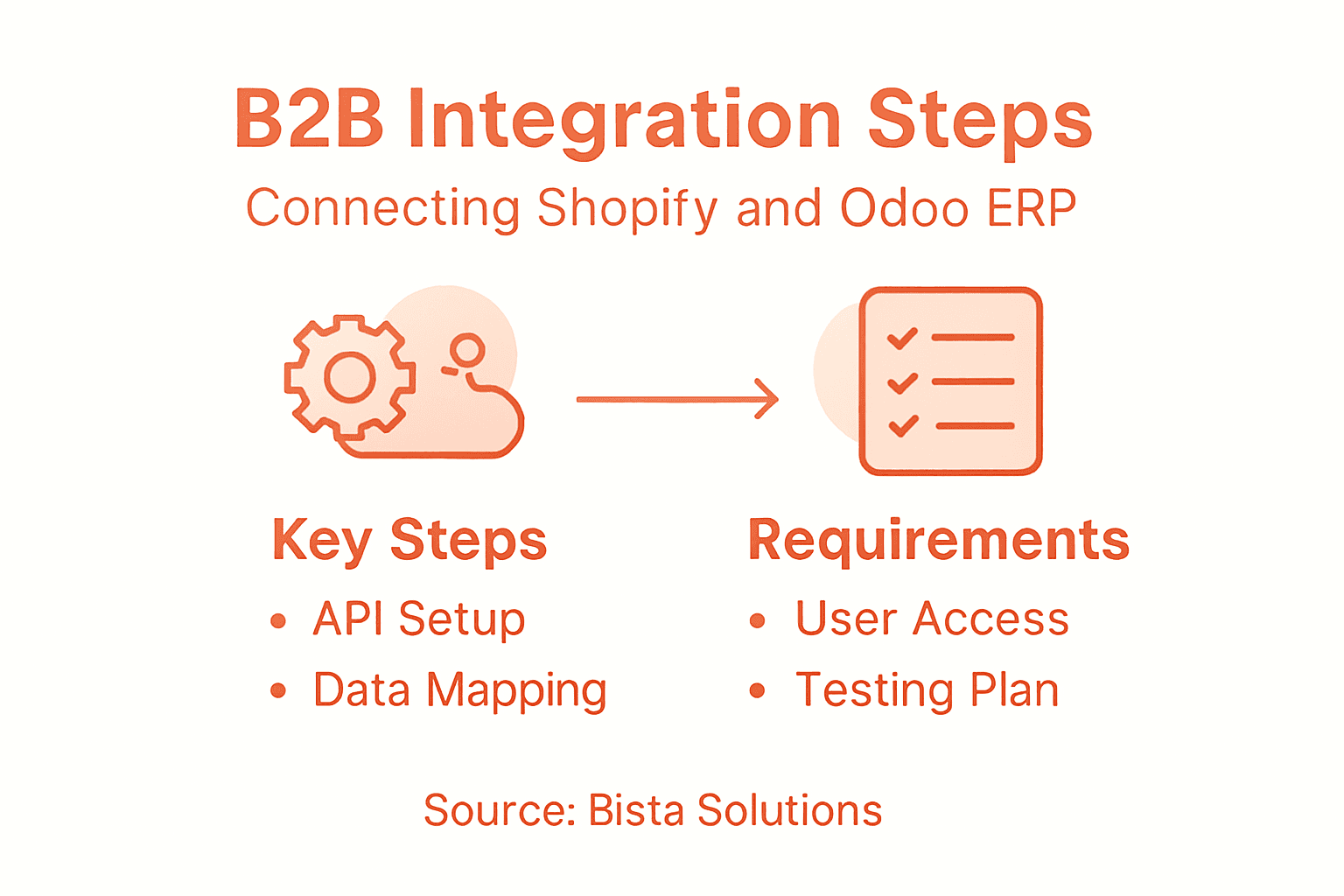
Successful integration of Shopify and Odoo ERP requires a methodical approach that balances technical precision with strategic business alignment. Implementation planning serves as the critical foundation, ensuring that the technological integration meets both immediate operational needs and long-term scalability objectives.
Core implementation steps include:
- Comprehensive business process mapping
- Technical infrastructure assessment
- API compatibility verification
- Data migration strategy development
- Security and authentication configuration
- User access and permission management
Companies must carefully evaluate their ERP implementation phases to ensure smooth system integration. The technical requirements demand robust API connections using protocols like REST or JSON-RPC, which enable seamless bidirectional data exchange between Shopify and Odoo. This involves configuring authentication mechanisms, establishing secure communication channels, and developing synchronization logic that can handle complex data transformations.
The implementation process typically involves three primary technical domains: data integration, workflow automation, and system compatibility. Each domain requires meticulous planning to ensure that product catalogs, inventory levels, customer information, and financial transactions flow smoothly between platforms without manual intervention. Successful integration hinges on creating a unified data model that can translate and map information across different system architectures while maintaining data integrity and real-time accuracy.
Pro tip: Engage a specialized integration partner who understands both Shopify and Odoo ecosystems to minimize potential technical challenges during the implementation process.
Common Integration Challenges and Solutions
Integrating Shopify and Odoo ERP presents several complex technical and organizational challenges that require strategic planning and sophisticated problem-solving approaches. Digital transformation demands a nuanced understanding of potential roadblocks and proactive mitigation strategies to ensure smooth system connectivity and operational efficiency.
Key integration challenges include:
- Data synchronization inconsistencies
- Incompatible system architectures
- Authentication and security complexities
- Performance bottlenecks
- User adoption and training barriers
- Customization limitations
Digital transformation strategies play a crucial role in addressing these challenges. Organizations must implement robust data governance frameworks that establish standardized data formats, validate information integrity, and create comprehensive mapping protocols between Shopify and Odoo systems. This approach minimizes potential synchronization errors and ensures consistent, reliable data exchange across platforms.
Addressing organizational resistance requires a multifaceted approach that combines technical solutions with strategic change management. Companies need to develop comprehensive training programs, create transparent communication channels, and demonstrate the tangible benefits of integration. Technical solutions must be complemented by user-centric design principles that prioritize intuitive interfaces and seamless workflow transitions, thereby reducing friction during system adoption.
This table summarizes common integration challenges and best-practice solutions:
| Challenge | Recommended Solution | Organizational Benefit |
|---|---|---|
| Data mismatches | Data standardization & mapping | Reliable information flow |
| Security gaps | Robust authentication protocols | Reduced risk exposure |
| User resistance | Targeted training programs | Smoother team adoption |
Pro tip: Conduct periodic integration audits and maintain open communication channels between IT teams and end-users to quickly identify and resolve potential system compatibility issues.
Unlock Seamless B2B Growth with Expert Shopify and Odoo ERP Integration
Are you struggling with complex workflows, data mismatches, and operational bottlenecks between your Shopify e-commerce platform and Odoo ERP system? The article highlights critical pain points like real-time inventory tracking, order automation, and unified data management that many B2B companies face when trying to scale efficiently. Integrating these powerful systems requires deep technical knowledge and strategic planning to eliminate data silos, improve automation, and enhance cross-department collaboration.
At Bista Solutions, we understand these challenges and specialize in delivering customized, scalable ERP implementations tailored specifically for B2B businesses. As the largest Odoo ERP implementer in North America and a multiple-time Odoo Best Partner, our team of over 300 experts provides comprehensive support to automate your business insights, streamline workflows, and unlock real-time operational visibility with Shopify and Odoo.
Leverage our proven expertise to overcome integration hurdles like data synchronization inconsistencies and user adoption barriers. Let us help you create a unified technology ecosystem that drives business agility and rapid growth.
Discover how our tailored Odoo ERP implementations can transform your Shopify-powered commerce by contacting us today.
Request A Free Demo
Ready to take your B2B operations to the next level? Reach out to Bista Solutions now through our contact page and start your journey toward seamless Shopify and Odoo integration. Don’t wait to experience the full potential of end-to-end process automation and business insight that only expert Odoo implementation can provide. Visit Bista Solutions to connect with a dedicated team poised to empower your digital transformation.
Frequently Asked Questions
What are the benefits of integrating Shopify with Odoo ERP for B2B businesses?
Integrating Shopify with Odoo ERP provides several benefits, including automatic product synchronization, real-time inventory tracking, streamlined order management and fulfillment processes, centralized customer data management, and enhanced financial reporting capabilities.
How does the Shopify and Odoo integration automate workflows?
The integration automates workflows by enabling automatic order processing across sales channels, real-time inventory synchronization, and centralized data management. This reduces manual interventions and errors, resulting in faster and more efficient business operations.
What are the key features of Odoo ERP that benefit B2B companies?
Odoo ERP offers advanced inventory management, integrated procurement and supply chain controls, sophisticated sales pipeline and customer relationship management, comprehensive financial reporting, and customizable production planning tools, all tailored for B2B enterprises.
What are the common challenges when integrating Shopify and Odoo ERP?
Common challenges include data synchronization inconsistencies, incompatible system architectures, authentication and security issues, performance bottlenecks, and user resistance to new systems. It’s essential to develop strategies to tackle these challenges effectively.
