

Why Growing SMEs Need Odoo ERP Explained
 by Uzlifat Mir
More than 80 percent of fast-growing SMEs face stalled progress because their systems cannot keep pace with their ambitions. Managing scattered spreadsheets, rising complexity, and disconnected processes can hold a business back just when opportunity knocks loudest. Choosing a solution like Odoo ERP offers a smarter way forward, empowering companies to work smarter, grow faster, and overcome the big challenges that threaten to slow them down.
Table of Contents
- Defining Odoo ERP for Growing SMEs
- Common Challenges Using Spreadsheets
- Key Signs It’s Time to Upgrade Systems
- How Odoo ERP Transforms Business Operations
- Comparing ERP Versus Spreadsheets for SMEs
Key Takeaways
| Point | Details |
|---|---|
| Odoo ERP for SMEs | Odoo offers a customizable, scalable ERP solution that streamlines operations for growing businesses. Its modular design allows companies to select only the necessary modules, avoiding high costs and complexity. |
| Spreadsheets Limitations | Relying on spreadsheets can lead to significant errors and inefficiencies, making it difficult for businesses to manage operations effectively as they grow. |
| Signs to Upgrade | Key indicators for system upgrades include data silos, scalability challenges, and high IT maintenance costs, suggesting the need for a more integrated ERP solution. |
| ERP vs. Spreadsheets | Transitioning from spreadsheets to an ERP system like Odoo enhances data integrity, real-time reporting, and collaboration, ultimately supporting strategic decision-making and business growth. |
Defining Odoo ERP for Growing SMEs
For small and medium enterprises navigating increasingly complex business landscapes, Odoo ERP emerges as a comprehensive software solution designed to streamline operations and drive growth. Unlike traditional enterprise resource planning systems that overwhelm smaller businesses, Odoo offers a modular, flexible approach tailored specifically to the unique challenges faced by growing companies.
At its core, Odoo is an open-source business application suite that integrates multiple critical business functions into a single, cohesive platform. The software covers an impressive range of operational needs, including CRM management, accounting, manufacturing, warehouse management, project tracking, and inventory control. What sets Odoo apart is its remarkable adaptability – businesses can select and implement only the modules they genuinely require, allowing for a truly customized enterprise management experience.
The modular design of Odoo makes it particularly powerful for SMEs seeking scalable technology solutions. Companies can start with basic modules and progressively add more sophisticated applications as their business complexity increases. This approach means you’re not investing in unnecessary features or getting locked into rigid, expensive systems. Key advantages for growing businesses include:
- Seamless integration across different business functions
- Cost-effective implementation compared to traditional ERP systems
- Ability to customize modules to match specific business workflows
- Scalable architecture that grows alongside your company
- Open-source flexibility allows continuous improvement
By providing an integrated platform that addresses multiple business needs simultaneously, Odoo empowers SMEs to operate with the efficiency and sophistication of much larger enterprises. As Bista Solutions’ years of implementation experience demonstrate, the right ERP solution isn’t about having the most complex system, but about having a tool that truly understands and adapts to your unique business requirements.
Common Challenges Using Spreadsheets
Spreadsheets have long been the default tool for small businesses tracking financial data, managing inventory, and recording critical business information. However, these seemingly simple documents harbor significant risks that can silently undermine business operations and decision-making processes. Research from computational studies reveals a startling truth: spreadsheet errors are not just occasional mistakes, but systematic problems that can dramatically impact business performance.
The most critical challenge with spreadsheets is their inherent error-prone nature. Academic research from arxiv.org demonstrates that spreadsheet errors occur in 0.8% to 1.8% of all formula cells. While these percentages might seem small, they translate into potentially catastrophic consequences for businesses. A single miscalculation in a financial model, inventory tracking sheet, or sales projection can lead to misguided strategic decisions, financial losses, and operational inefficiencies.
Beyond calculation errors, spreadsheets present multiple operational challenges for growing businesses:
- Manual Data Entry Risks: High probability of human error during data input
- Version Control Complexity: Multiple team members creating different spreadsheet versions
- Limited Collaboration Capabilities: Difficulty in real-time data sharing and updates
- Scalability Limitations: Increasing complexity as business data grows
- Lack of Advanced Reporting: Restricted ability to generate comprehensive business insights
These limitations become increasingly problematic as businesses expand. What starts as a manageable tracking method quickly becomes a tangled web of interconnected spreadsheets that are difficult to maintain, validate, and leverage for strategic decision-making. By transitioning to an integrated ERP solution like Odoo, businesses can eliminate these spreadsheet-related challenges and establish a more robust, reliable system for managing their critical operational data.

Key Signs It’s Time to Upgrade Systems
Growing businesses often struggle to recognise when their current systems have become more of a hindrance than a help. The transition from manual processes and disconnected software to an integrated Enterprise Resource Planning (ERP) solution like Odoo isn’t just a technological upgrade—it’s a strategic transformation that can define a company’s future competitiveness. Understanding the critical signs of system limitations is crucial for business leaders looking to stay ahead in today’s rapidly evolving marketplace.
System inefficiency becomes the first red flag for most growing businesses. When employees spend more time manually transferring data between different applications, reconciling inconsistent information, or dealing with frequent errors, it’s a clear indicator that your current system is holding you back. These inefficiencies not only consume valuable time but also increase the risk of costly mistakes that can impact your bottom line. Imagine a scenario where your sales team can’t quickly access inventory data, or your finance department struggles to generate accurate financial reports—these are telltale signs that your business has outgrown its current technological infrastructure.
Several key indicators suggest it might be time to upgrade your business systems:
- Data Silos: Information is trapped in separate systems with no seamless communication
- Scalability Challenges: Current tools can’t handle increasing business complexity
- Reporting Limitations: Difficulty generating comprehensive, real-time business insights
- Increased Manual Workarounds: Employees constantly create manual processes to compensate for system limitations
- High IT Maintenance Costs: Spending more on maintaining legacy systems than on business growth
The most compelling argument for a system upgrade is the potential for transformation. An integrated ERP solution doesn’t just solve immediate operational challenges—it provides a strategic platform for growth.
By consolidating multiple business functions into a single, intelligent system, businesses can unlock unprecedented levels of efficiency, gain real-time insights, and create a more agile, responsive organizational structure. The cost of maintaining outdated systems far exceeds the investment in a modern, scalable ERP solution that can adapt and grow alongside your business.
How Odoo ERP Transforms Business Operations
Odoo ERP represents a revolutionary approach to business management, transforming traditional operational models into dynamic, interconnected ecosystems of efficiency. By integrating multiple business functions into a single, intelligent platform, Odoo empowers businesses with intelligent automation that goes far beyond simple data management. This holistic approach allows companies to break down departmental silos, streamline communication, and create a more responsive, adaptive organizational structure.
Business process optimization stands at the core of Odoo’s transformative capabilities. Unlike traditional software that requires businesses to adapt to rigid systems, Odoo offers unprecedented flexibility. Each module can be customized to match specific workflow requirements, ensuring that technology serves your unique business needs rather than constraining them. Imagine a scenario where your sales team, inventory management, and financial reporting seamlessly communicate in real-time, eliminating manual data transfers and reducing the potential for human error.
The transformative impact of Odoo ERP spans multiple critical business dimensions:
- Operational Efficiency: Automated workflows reduce manual tasks and increase productivity
- Real-Time Insights: Comprehensive dashboards provide instant visibility into business performance
- Scalable Architecture: Modular design allows businesses to add functionality as they grow
- Cost Reduction: Consolidated platform eliminates the need for multiple disparate software solutions
- Enhanced Collaboration: Integrated communication tools break down interdepartmental barriers
Ultimately, Odoo ERP is more than just a software solution—it’s a strategic enabler of business transformation. By providing a unified platform that adapts to your evolving business needs, Odoo helps companies move from reactive management to proactive strategic planning. The ability to customize, scale, and integrate various business functions means that growing SMEs can build a technological foundation that supports their most ambitious growth objectives, turning potential limitations into opportunities for innovation and expansion.
Comparing ERP Versus Spreadsheets for SMEs
For small and medium enterprises, the choice between traditional spreadsheets and modern Enterprise Resource Planning (ERP) systems represents a critical strategic decision that can fundamentally impact business performance. While spreadsheets have long been the default tool for business data management, they are increasingly revealing significant limitations that can hinder growth and operational efficiency. Understanding the comparative landscape of ERP solutions becomes crucial for businesses looking to make informed technological investments.
Research from computational studies highlights the inherent vulnerabilities of spreadsheet-based systems. Academic research from arxiv.org demonstrates that spreadsheets used for critical business functions are prone to high error rates, with errors occurring in 0.8% to 1.8% of formula cells. In contrast, ERP systems provide robust frameworks with built-in controls and validation mechanisms that dramatically reduce the potential for costly mistakes. These integrated systems offer a level of reliability and sophistication that spreadsheets simply cannot match, transforming data management from a manual, error-prone process to an intelligent, automated workflow.
Key differences between spreadsheets and ERP systems become apparent across multiple dimensions:
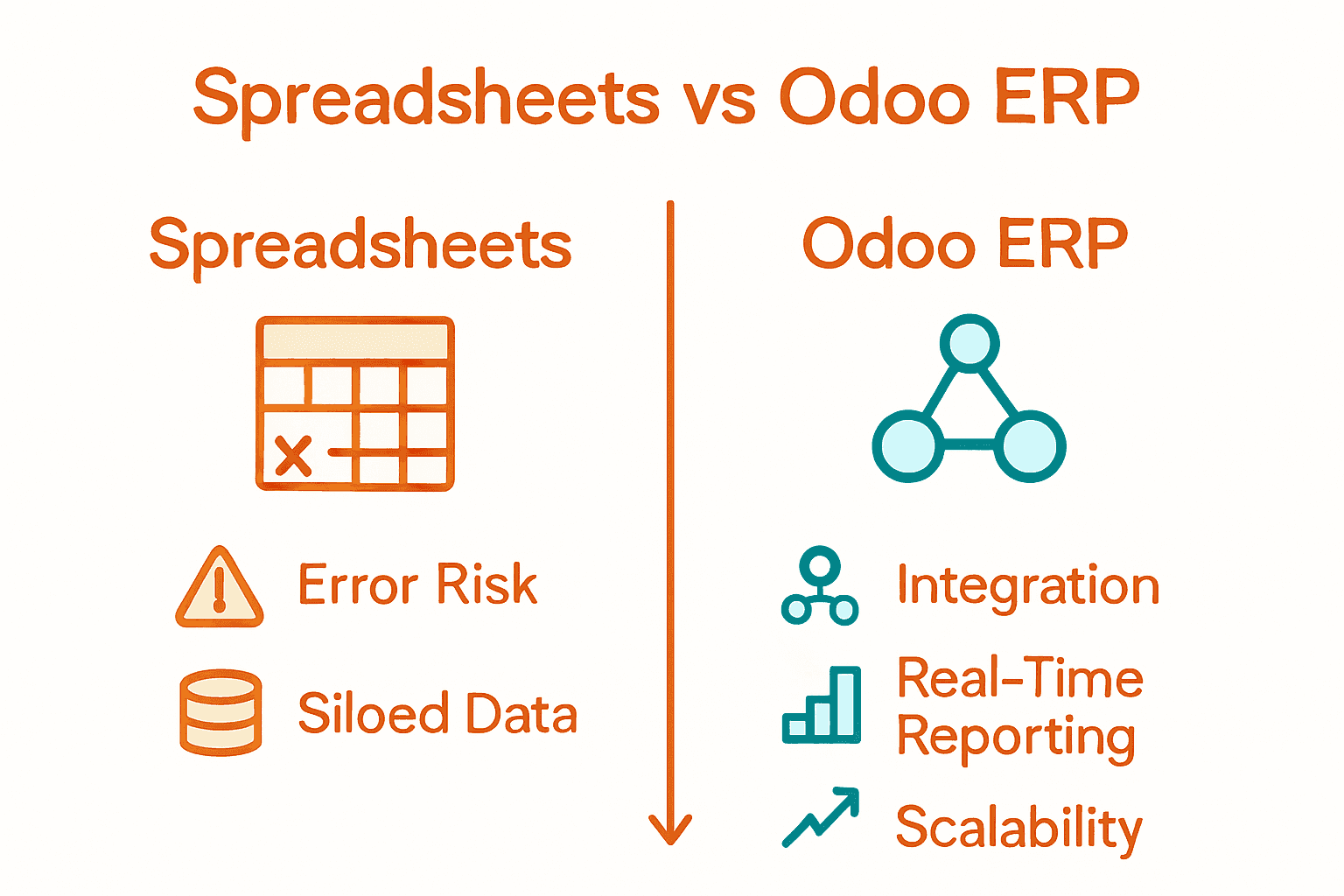
- Data Integrity: ERP systems provide centralised, validated data sources
- Scalability: Seamless expansion of functionality as business needs grow
- Real-Time Reporting: Instant insights across multiple business functions
- Collaboration: Simultaneous multi-user access with controlled permissions
- Security: Advanced data protection and access control mechanisms
Ultimately, the transition from spreadsheets to an ERP solution like Odoo represents more than a technological upgrade—it’s a strategic transformation. Small and medium enterprises that embrace integrated systems position themselves to move beyond mere data tracking, gaining the ability to generate actionable insights, streamline operations, and create a more agile, responsive business infrastructure. The initial investment in an ERP system pays dividends through improved efficiency, reduced errors, and the capability to make more informed, data-driven decisions that can significantly impact long-term business success.
Unlock Growth with Expert Odoo ERP Implementation
Growing SMEs face challenges like managing scattered data, avoiding costly spreadsheet errors, and scaling operations without inefficiency. The article highlights how Odoo ERP’s modular, customizable platform can eliminate data silos, reduce manual work, and provide real-time insights essential for today’s fast-paced business environment. If you are ready to transform your workflows and gain a competitive edge with a system built to grow with you, expert guidance is critical.
At Bista Solutions, we understand these pain points deeply. As the largest Odoo ERP implementer in North America and a trusted Odoo Gold Partner, our team of over 300 ERP professionals has delivered 350+ successful implementations tailored to diverse business needs. We help you move beyond disjointed spreadsheets and outdated systems by designing scalable solutions that increase efficiency, improve data integrity, and empower smarter decisions.
Explore how our customized Odoo ERP services connect seamlessly with your goals at Bista Solutions Contact.
Contact Us Here
Take the first step toward streamlined growth today. Don’t let inefficiencies slow down your success. Connect with the Odoo implementation experts at Bista Solutions now and start building an ERP system that adapts and scales with your business. Your optimal technology foundation is just a click away.
Frequently Asked Questions
What is Odoo ERP, and how does it benefit growing SMEs?
Odoo ERP is a comprehensive, open-source business application suite designed to streamline various business functions such as CRM, accounting, and inventory management. It benefits growing SMEs by offering a modular approach, allowing them to customize and scale the system according to their specific needs while improving operational efficiency and reducing costs.
How can Odoo ERP help eliminate spreadsheet-related issues?
Odoo ERP helps eliminate spreadsheet-related issues by providing a centralised platform that reduces manual data entry, prevents errors, and facilitates real-time collaboration. Unlike spreadsheets, Odoo integrates various business functions, helping businesses avoid data silos and operational inefficiencies.
What are the key signs that an SME should transition to Odoo ERP?
Key signs include increasing data silos, scalability challenges with current tools, difficulties in generating real-time reports, excessive manual workarounds, and high IT maintenance costs for legacy systems. If businesses experience these challenges, it’s a strong indication that they should consider upgrading to Odoo ERP.
How does Odoo ERP enhance operational efficiency for SMEs?
Odoo ERP enhances operational efficiency through automated workflows, real-time insights, and a modular design that allows businesses to incrementally add functionalities as needed. This integration eliminates redundant tasks, improves communication between departments, and supports proactive strategic planning.
